The new book presents a timely approach to combining human insight and artificial intelligence to drive faster, smarter, and more resilient decisions, as outlined by global supply chain and AI thought leaders.

Atlanta, GA –  October 1, 2025Logility, an Aptean company, and a leading provider of AI-first supply chain management solutions, today announced the upcoming release of The AI Compass for Supply Chain Leaders: How Generative, Agentic, and Narrow AI are Reshaping Strategy, Planning, and Execution.

Authored by Piet Buyck, SVP Solution Principal at Logility, the book offers supply chain professionals and executives a practical roadmap to move beyond static, numbers-based planning and adopt a dynamic, insight-driven approach powered by artificial intelligence (AI).

With global supply chains facing unprecedented volatility—from tariffs and geopolitical tensions to shifting consumer preferences and rising costs—traditional planning tools, such as spreadsheets and siloed systems, are failing companies when they need reliable insights most. The insights provided address a void supply chain leaders seek to fill with proven strategies to integrate AI solutions that deliver measurable results into their operations.

The AI Compass for Supply Chain Leaders introduces a bold new approach to supply chain planning where AI systems and human insight work together to drive faster, smarter, and more resilient decisions.

“For decades, planning remained a deeply manual and often painfully analog discipline, even as technology evolved. The challenge was never just about the math; it was about the people, the processes, and the implications of change,” said Piet Buyck. “The AI Compass for Supply Chain Leaders is about rethinking how we plan, align, and communicate between systems, departments, and people. This book is for those who want to stop drifting—and start navigating with purpose.”

Drawing on extensive research and real-world applications, the book reveals how organizations can thrive in uncertainty by adopting an AI-first strategy. Readers will discover how to:

  • Replace outdated number-based planning with real-time digital insights
  • Align cross-functional teams through natural language collaboration
  • Use AI to sense demand, manage risk, and seize opportunity—before your competitors do
  • Build a planning culture that’s agile, transparent, and future-ready

For companies that effectively combine AI systems and human expertise, the results can be dramatic, often positioning them to outgrow their competitors’ profit margins by 6%, create plans for as little as 30% of the cost, and achieve up to 20% higher forecast accuracy.

“This book is timely and essential; it doesn’t just describe the future—it equips you to lead it,” writes Nancy Haines, Senior Vice President at Aptean, in the book’s foreword. “This is not about replacing human decision-makers. It’s about empowering them with tools that speak their language and amplify their impact.” 

The AI Compass for Supply Chain Leaders is available by request through https://www.logility.com/l/ai-compass-for-sc-leaders/

###

About Piet Buyck 

Piet Buyck is a global technology executive with over 30 years of experience in managing and positioning high-value IT applications that disrupt current practices. He is well-known as an influential and strategic business thought leader and entrepreneur with significant achievements and expertise in artificial intelligence, demand sensing, and demand planning. As Senior Vice President, Innovation Strategies at Logility, Piet is on a crusade to make artificial intelligence for planning easy, accessible, and explainable while keeping human decision-makers in control.

About Logility

Logility, an Aptean company, is a market-leading provider of AI-first supply chain management software engineered to help organizations build sustainable digital supply chains that improve people’s lives and the world we live in. Logility’s fully integrated, AI-driven end-to-end platform helps clients know faster, turn uncertainty into opportunity, and transform supply chain from a cost center to an engine for growth. Learn more at www.logility.com.

About Aptean

Aptean is a global provider of industry-specific software that helps manufacturers and distributors effectively run and grow their businesses. Aptean’s solutions and services help businesses of all sizes to be Ready for What’s Next, Now®. Aptean is headquartered in Alpharetta, Georgia and has offices in North America, Europe and Asia-Pacific. To learn more about Aptean and the markets we serve, visit www.aptean.com.

Logility is a Registered Trademark of Logility, Inc. Aptean and Ready for What’s Next, Now are Registered Trademarks of Aptean, Inc. All other company and product names are trademarks of the respective companies with which they are associated.

This article provides a comprehensive guide to mastering demand planning and forecasting, emphasizing the importance of integrating advanced technology, data accuracy, and cross-departmental collaboration for effective supply chain management. By exploring key strategies, tools like Logility, and best practices, businesses can enhance their ability to predict customer demand and optimize inventory levels, ultimately driving operational efficiency and profitability.

Introduction

Demand planning and forecasting are vital for business success. They help predict future customer demand accurately. This ensures that businesses can meet customer needs efficiently. Effective demand planning reduces inventory costs. It also boosts customer satisfaction and increases profitability. These benefits make it a crucial part of supply chain management.

  • Demand forecasting uses historical data and market trends. It employs statistical models to predict future demand. This process is analytical and data-driven.
  • Demand planning is broader. It includes forecasting, inventory management, and sales operations planning. It is proactive and strategic in nature.

The right tools can automate data collection and analysis. This improves accuracy and efficiency.

Demand sensing technology is a game-changer. It uses real-time data to improve short-term forecasts. This allows businesses to respond quickly to market changes. Collaboration across departments is essential. Sales, marketing, finance, and operations must work together. This ensures successful demand planning.

Understanding these concepts is key. It helps businesses optimize inventory levels and reduce stockouts. It also minimizes excess stock.

This guide will explore these strategies in detail and provide insights into tools and technologies that will allow you to mastering demand planning and forecasting.

Understanding Demand Planning and Forecasting

Demand planning and forecasting play a pivotal role in strategic decision-making. Businesses rely on these processes to align production with customer demand. This alignment is crucial for maintaining efficiency and effectiveness.

Demand planning involves more than just predictions. It includes analyzing data, coordinating across departments, and setting strategic goals. Each of these actions contributes to the broader scope of demand planning.

Forecasting, on the other hand, is a precise science. It focuses on using data and trends to predict future demand levels. These predictions are vital for planning production and managing resources.

The importance of demand planning and forecasting cannot be overstated. They are fundamental for maintaining a competitive edge. Businesses that excel in these areas tend to outperform their competitors.

The following sections will delve deeper into definitions, importance, and components. By understanding these elements, organizations can enhance their operational strategies.

What is the Definition and Importance of Demand Planning and Forecasting?

Demand planning integrates several processes, aiming to meet customer demand profitably. It encompasses sales, operations, and finance to create a cohesive strategy. Proper demand planning can align production schedules with demand expectations.

Forecasting provides a data-based prediction of future demand. It uses historical sales, industry trends, and statistical analyses. These elements create a picture of what future sales might look like.

Both demand planning and forecasting focus on different timelines. Planning generally looks at the broader, long-term picture. Forecasting tends to focus more on the short-to-medium term.

The significance of demand planning and forecasting lies in their capability to improve resource allocation. They help businesses minimize waste and ensure stock availability. This results in enhanced customer satisfaction and better financial returns.

In summary, demand planning brings disparate business activities together. It ensures cohesive functioning across various departments and forecasted demand drives crucial decision-making. Together, they form the cornerstone of a successful business strategy.

Key differences between them include:

  • Scope and Focus: Planning is comprehensive; forecasting is data-centric.
  • Timeframe: Planning covers long-term goals; forecasting addresses short-term needs.
  • Approach: Planning is strategic; forecasting is analytical.

Key Components

Demand planning comprises several elements, each contributing to the overall process. Understanding these components is essential for effective execution.

Firstly, data accuracy is crucial. Reliable data sources lead to better demand predictions. Ensuring data quality helps in forming a solid foundation for planning efforts.

Secondly, cross-functional collaboration plays a significant role. Collaboration between sales, marketing, and operations ensures all departments work toward common goals. This alignment reduces misunderstandings and inefficiencies.

Another key component is technology. Demand planning and forecasting software enhances data analysis and reporting.

Additionally, scenario planning and “what-if” analysis are vital. They allow businesses to anticipate different market conditions. This preparedness enables better response to unforeseen events.

Continuous monitoring and refinement are essential. The business environment is dynamic, and demand plans must be adaptable. Regular reviews help adjust strategies and ensure they remain effective.

To encapsulate, successful demand planning involves:

  • Data Accuracy: Reliable data for precise predictions.
  • Collaboration: Cross-departmental teamwork for cohesive goals.
  • Technology: Software tools for enhanced accuracy.
  • Scenario Planning: Preparing for variable market conditions.
  • Monitoring and Adjustment: Adapting plans based on ongoing reviews.

In understanding these components, businesses can create robust demand planning strategies. These strategies can then drive growth, efficiency, and customer satisfaction.

What is Demand Planning vs Demand Forecasting

Understanding the nuances between demand planning and forecasting is critical. These processes, though interrelated, have distinct focuses and implications for businesses. Both are integral parts of supply chain management, yet they cater to different stages and objectives.

Demand planning is a broader term that encompasses several activities. It seeks to align the demand with production capabilities. This involves ensuring that resources are allocated in a way that minimizes waste and maximizes efficiency.

Forecasting, on the other hand, is more narrowly focused. Its primary aim is to predict future demand based on a variety of data inputs. It involves creating models and analyses that predict specific future conditions, particularly sales levels.

It’s crucial for professionals in operations and supply chain roles to grasp these distinctions. Misunderstanding them can lead to misaligned strategies, affecting overall business efficiency. Therefore, understanding each aspect can contribute to more informed decision-making.

Understanding these differences allows businesses to tailor their strategies more effectively. Each process has its own set of best practices that, when employed correctly, can provide a significant competitive advantage.

Differences Explained

The primary difference between demand planning and forecasting lies in their scope and purpose. While planning is strategic, forecasting is more analytical.

Demand planning covers a broad range of activities. It includes coordinating resources, refining supply chain processes, and managing inventory. The aim is to meet customer demand efficiently while minimizing costs.

In contrast, demand forecasting is primarily about analysis. It uses historical data and market trends to generate future demand projections. These projections help in making informed decisions about inventory and production schedules.

The time horizon also differs significantly. Demand planning often covers longer-term strategic initiatives, possibly spanning years. Forecasting tends to address shorter-term, more immediate requirements.

In sum, the key differences include:

  • Scope: Planning is comprehensive; forecasting is focused.
  • Approach: Planning is strategic; forecasting is analytical.
  • Timeframe: Planning is long-term; forecasting is short-term.

Understanding these distinctions is crucial. It ensures that businesses apply the right strategies at the right time.

When to Focus on Each

Determining when to prioritize demand planning over forecasting depends on several factors. Businesses need to assess their current market conditions and strategic goals.

Demand planning is essential when considering broader operational changes. For instance, if a company is looking at expansion, effective planning ensures resources align with expected demand increases. It helps in anticipating future needs and preparing accordingly.

Forecasting becomes critical when addressing immediate issues. For example, during peak seasons like holidays, accurate forecasting helps maintain inventory levels that meet consumer demand. This precision is vital to avoid stockouts or excess stock.

When launching new products, both planning and forecasting are essential. Planning ensures adequate resources are allocated for production and marketing. Forecasting helps estimate the likely demand, thereby informing initial inventory levels.

Thus, business activities often dictate the focus:

  • Strategic Shifts: Prioritize demand planning.
  • Immediate Demand Adjustments: Focus on forecasting.
  • New Product Launches: Combine both for comprehensive strategy.

Recognizing the right moments to concentrate on either process can significantly impact success. This balance drives efficiency and effectiveness, enhancing overall business performance.

Examples of Effective Demand Planning

Exploring successful demand planning examples can offer valuable insights. Many industries have applied innovative strategies to refine their processes. These real-world cases reveal methods that can be adapted across various contexts.

Retailers frequently rely on demand planning to anticipate peak season demands. For example, large chain stores use historical sales data combined with market analysis. This approach helps forecast demand during holidays, optimizing stock levels and improving sales outcomes.

The automotive industry also showcases effective demand planning. Car manufacturers align their production schedules with anticipated demand. They consider factors like new model releases and economic indicators. This synchronization minimizes production delays and excess inventory.

Food and beverage companies similarly benefit from demand planning. With perishable goods, accurate demand forecasts are crucial. Predictive models help manage supply chain operations and ensure fresh stock, reducing waste.

Pharmaceutical firms use demand planning to prevent shortages of critical medications. They predict seasonal health trends to adjust inventory accordingly. This readiness ensures essential drugs remain available when demand spikes.

In these industries, demand planning bridges the gap between anticipating customer needs and meeting them. Success hinges on tailoring strategies to specific business challenges and opportunities.

Industry Case Studies

Analyzing industry case studies reveals how demand planning transforms operations. Let’s explore a few notable examples.

Retail Giants: A global retailer incorporated machine learning in its demand planning. By analyzing purchasing patterns, it adjusted inventory levels dynamically. This resulted in a 20% reduction in stockouts during peak shopping periods.

Automotive Advances: An automotive company leveraged demand sensing technology. By integrating real-time market data, it fine-tuned production schedules. The approach led to a 15% reduction in manufacturing lead times.

Food and Beverage: A leading beverage producer utilized cloud-based software for demand planning. By simulating various demand scenarios, it optimized distribution routes. The company reported a 10% decrease in delivery times, improving customer satisfaction.

Pharmaceutical Precision: A major drug manufacturer adopted AI-driven forecasting. By considering factors like flu season projections, it improved its stock readiness. This strategy reduced shortage instances by 25% over two years.

These examples underscore the importance of integrating technology. Whether through machine learning or cloud solutions, businesses gain a decisive edge.

Lessons Learned

Drawing lessons from these examples enhances our understanding of demand planning. Each case study emphasizes key takeaways applicable to other industries.

Firstly, leveraging technology is paramount. From AI to cloud software, technology enhances accuracy and responsiveness. Industries that embrace these tools experience notable improvements in their operations.

Secondly, real-time data is a game-changer. Demand sensing technology offers critical insights into market shifts. Businesses leveraging real-time insights respond swiftly to changes, gaining a competitive advantage.

Finally, cross-functional collaboration is essential. Involving various departments ensures a holistic view of demand patterns. This integrative approach leads to more effective and agile demand planning.

These lessons demonstrate that effective demand planning requires a multifaceted approach. Embracing technology, collaboration, and real-time data can drastically enhance planning outcomes. Businesses poised to adapt these strategies are better positioned for success.

Technology in Demand Planning

Technology plays a pivotal role in modern demand planning, transforming traditional methods. It integrates vast data sources, enabling precise and quick decision-making. This evolution enhances businesses’ abilities to anticipate consumer needs more accurately.

One technology at the forefront is demand sensing. Unlike traditional forecasting, demand sensing uses real-time data. This approach allows companies to adjust quickly to market changes. It reduces errors and forecasts demands with a much shorter time horizon.

Moreover, advanced analytics tools have become indispensable. These tools process large datasets, uncovering hidden demand patterns. Incorporating machine learning enhances these analyses by improving predictive accuracy over time.

Cloud-based demand planning software is also gaining traction. It offers scalability and easy access for global teams. The integration with other business systems, like CRM and ERP, enhances data flow and operational efficiency.

Demand Sensing Technology

Demand sensing technology offers new potential in forecasting. By using point-of-sale data and social media trends, it refines demand predictions. This technology decreases forecast errors significantly, offering agility in planning.

Demand sensing enables companies to anticipate short-term demands. This allows for swift supply chain adjustments, minimizing disruptions. Real-time data capture from various sources sharpens the accuracy of predictions.

Some benefits of demand sensing include:

  • Reduced stockouts: Ensures products are available when and where they’re needed.
  • Improved customer service: Responds rapidly to changing consumer preferences.
  • Enhanced inventory management: Balances stock levels, reducing excess and waste.

Using demand sensing technology aids organizations in achieving a responsive supply chain. The technology’s adaptability to real-time market signals is unmatched.

Using AI to Advance Demand Planning

Artificial Intelligence (AI) is transforming demand planning, setting new standards in accuracy. Leveraging AI, businesses can now process large data volumes with incredible speed. The result is more precise and timely demand forecasts that drive strategic decisions.

AI models learn from past data, identifying patterns and trends undetectable by humans. This learning process improves over time, continually enhancing forecast reliability. By predicting customer demand more accurately, businesses can optimize their supply chains.

AI-driven tools also allow for scenario analysis, evaluating multiple potential futures. This capability helps businesses prepare for uncertainties, ensuring resilience in volatile markets. Moreover, AI integrates smoothly with existing systems, from ERP to CRM platforms.

Additionally, AI’s role in real-time data analysis is noteworthy. It helps businesses adapt quickly to sudden market shifts, maintaining service levels. By reducing forecast errors, AI tools minimize excess inventory and stockouts, enhancing operational efficiency.

To enhance the “Current Trends Using AI for Demand Forecasting” section by incorporating content related to Logility and generative AI, I’ll rewrite it as follows:

Current AI trends in demand forecasting highlight the use of machine learning and generative AI, which are transforming traditional forecasting methods. Generative AI, in particular, is making strides by enabling businesses to not only predict future demand but also create scenarios that can help in strategic planning.

Logility, a leader in supply chain optimization, emphasizes the importance of AI-driven analytics for refining demand forecasts. Their advanced solutions provide businesses with the ability to leverage historical data and generate insights that enhance decision-making. By utilizing predictive analytics, organizations can forecast future sales trends and optimize inventory levels, ensuring they meet consumer demand efficiently.

One vital application of generative AI is its capability to simulate various market scenarios and outcomes. This technology can analyze vast datasets, incorporating factors such as seasonal patterns, promotional events, and customer behavior. Businesses can use these AI-generated scenarios to explore potential demand fluctuations, enabling them to prepare more accurately for future market conditions.

Key AI trends in demand forecasting include:

  • Generative AI Capabilities: This technology allows companies to create models that simulate different demand scenarios based on real-time data, enhancing adaptability in planning.
  • Automated Demand Sensing: Leveraging Logility’s advanced analytics, businesses can utilize real-time data inputs to continuously adjust their forecasts, thus reducing reliance on manual processes.
  • Enhanced Accuracy and Flexibility: AI significantly narrows the demand-supply gap. Combining generative AI with traditional forecasting methods enables companies to optimize inventory and meet customer needs promptly.
  • Data Integration and Collaboration: Incorporating both internal and external data sources, as seen in Logility’s integrated solutions, provides a comprehensive view of market dynamics, boosting forecast reliability.

By embracing these AI innovations, businesses can proactively manage demand fluctuations with unmatched precision, ensuring they are well-prepared for an ever-changing marketplace.

Feel free to let me know if you would like any further adjustments or additions!

The Future of AI in Demand Planning

The future of AI in demand planning promises even greater integration and sophistication. AI technologies will continually evolve, offering smarter solutions tailored to various industries. Innovations will likely focus on increasing speed and reducing latency in response times.

One promising future aspect is the integration of IoT data with AI models. This synergy will provide deeper insights into consumer behavior and preferences. These insights could lead to hyper-personalized experiences, aligning supply with exact demand.

Potential developments in AI for demand planning:

  • Advanced real-time analytics: Continuous improvement in AI algorithms will enhance real-time decision-making.
  • Predictive maintenance: AI tools will predict not just demand, but also operational disruptions, enabling preventive actions.
  • Greater collaboration tools: Future AI platforms will enhance cross-departmental collaboration, aligning diverse teams.

By harnessing AI’s full potential, businesses will achieve more agile and responsive demand planning. This will not only improve operational efficiency but also elevate overall customer satisfaction.

Logility stands out as a premier demand planning and forecasting tool, renowned for its comprehensive suite of solutions that leverage advanced artificial intelligence (AI) capabilities. By integrating AI-driven analytics into its platform, Logility enables businesses to make informed decisions based on accurate demand forecasts that enhance operational efficiency.

One of the key features of Logility is its ability to utilize machine learning algorithms that analyze historical data and market trends. This AI capability allows organizations to identify patterns and predict future demand with remarkable accuracy. The system continually learns from new data inputs, improving its predictive models over time to ensure that businesses remain agile and responsive to market changes.

Logility’s demand planning tools also facilitate scenario planning through sophisticated AI simulations. Businesses can explore multiple demand scenarios based on various factors such as seasonality, promotional activities, and consumer behavior trends. This ability to visualize different outcomes empowers companies to prepare strategically for fluctuating demand and optimize inventory levels accordingly.

Additionally, Logility promotes data integration across various business functions. By incorporating real-time data from internal and external sources, the platform delivers a comprehensive view of the supply chain. This holistic approach enhances collaboration between teams, ensuring that everyone is aligned in their planning efforts, thus reducing discrepancies and improving response times.

In summary, Logility offers a robust demand planning solution that effectively harnesses AI technology to refine demand forecasting processes. Its capabilities not only support accurate predictions but also drive agility and collaboration across departments—making it an invaluable tool for businesses seeking to optimize their supply chain performance and meet evolving customer demands efficiently.

Best Practices for Success

Successful demand planning and forecasting rely on several best practices. These practices are grounded in consistency, collaboration, and adaptability. Adopting them can lead to greater efficiency and accuracy in forecasting.

One critical practice is ensuring data quality. Reliable forecasts depend on accurate, timely, and relevant data. Businesses must strive to maintain clean data systems. This involves regular audits and updates to ensure integrity.

Another best practice is leveraging technology wisely. Utilize advanced tools that automate data collection and analysis. Demand planning software can streamline processes, saving time and reducing errors. It’s vital to choose software that aligns with business needs and integrates with existing systems.

Cross-functional collaboration plays a huge role. It fosters diverse insights and aligns goals. Involve teams from sales, marketing, and finance in the planning process. By doing so, you ensure cohesive strategies that reflect entire organizational needs.

Continuous improvement is also essential. Regularly review and adjust demand planning processes. Market conditions change, and so must forecasting methods. Use feedback loops and key performance indicators (KPIs) to measure success.

Here are some best practices to consider:

  • Data accuracy and validation: Continuously monitor data sources to eliminate inaccuracies.
  • Leveraging technology: Adopt the latest tools that offer robust analytics and real-time insights.
  • Cross-functional collaboration: Engage various departments to ensure comprehensive planning and forecasting.
  • Regular process reviews: Adapt strategies based on outcomes to improve future forecasts.

Implementing these practices leads to improved demand planning, benefiting both operations and customer satisfaction.

Collaboration Across Teams

For demand planning, teamwork is key. Collaboration across multiple departments strengthens the planning process and enhances results. When various teams share insights, planning becomes more robust.

Sales and marketing teams provide valuable market insights. Their understanding of customer trends and upcoming promotions informs demand forecasting. Meanwhile, finance teams ensure the alignment of forecasts with budgets and financial goals.

To foster effective collaboration, establish regular communication channels. Schedule joint meetings to discuss forecasts and align strategies. Promote an environment where each team member can contribute ideas freely.

Additionally, using collaborative tools enhances teamwork. Platforms like shared dashboards and cloud-based systems ensure everyone has access to the same data. This transparency enhances decision-making and unifies efforts.

Collaborative teams ensure better demand planning through:

  • Shared objectives: Align department goals with organization-wide strategies.
  • Regular updates: Keep all teams informed of changes and new trends.
  • Integrated tools: Use common platforms for seamless collaboration.

By fostering collaboration, businesses can create more accurate demand plans, benefiting operational efficiency.

Continuous Improvement and Adaptation

Continuous improvement and adaptation are vital for sustaining successful demand planning. Markets evolve, and so should planning strategies. Businesses must be proactive in revising their approaches.

Begin by setting clear performance metrics. Metrics provide a framework for measuring forecast accuracy and operational success. Regularly track these indicators to identify areas that need improvement.

Feedback loops are also beneficial. Gather insights from post-implementation reviews to refine processes. Use these insights to address weaknesses and enhance future strategies.

Embrace flexibility in planning. Be ready to pivot when market conditions shift. Adopt a mindset that welcomes change. By being adaptable, businesses can quickly respond to new opportunities and risks.

Key steps for continuous improvement include:

  • Establishing performance metrics: Define and monitor KPIs to gauge success.
  • Implementing feedback mechanisms: Collect and apply feedback to refine planning strategies.
  • Promoting adaptability: Foster a flexible approach to accommodate market changes.

With continuous improvement, demand planning becomes more resilient and effective, ensuring long-term organizational growth.

Conclusion

Mastering demand planning and forecasting is essential for any business aiming to thrive in today’s dynamic marketplace. As we’ve explored throughout this guide, effective demand planning goes beyond merely predicting customer needs; it encompasses strategic collaboration, advanced technology integration, and continuous adaptation to changing market conditions. By leveraging powerful tools like Logility, organizations can harness the power of AI to streamline processes, improve accuracy, and enhance decision-making.

As businesses navigate the complexities of supply chain management, understanding the key components of demand planning and forecasting will provide a competitive edge. Companies that prioritize data accuracy, cross-functional teamwork, and innovative technologies will not only meet customer demand effectively but also drive profitability and operational efficiency.

Incorporating best practices and embracing advanced technologies will empower businesses to respond swiftly to market fluctuations, anticipate consumer needs, and optimize their inventory levels. Ultimately, mastering demand planning and forecasting is not just about predicting the future; it’s about strategically positioning a business for sustained growth and success in an ever-evolving landscape.

AI Automated Order Allocation is the ability to continuously and transparently optimize allocation decisions by actively monitoring your demand and supply landscape while keeping decisions aligned with strategic business objectives.

AI-powered automated order allocation helps supply chain leaders reduce costs, improve fulfillment accuracy, and protect margins by replacing manual processes with intelligent, real-time decision-making.

Look around, and nearly every company is talking about AI. It’s on every boardroom agenda, woven into annual reports, and showcased at industry events. And it’s even embedded somewhere in 97% of supply chains, according to Logility’s Supply Chain Horizons 2025 market study.

But dig a little deeper, and the reality of AI adoption is far more complex in supply chains. Only 33% are applying the technology to solve supply chain-specific challenges, such as order fulfillment or allocation. And when it comes to high-stakes areas that directly impact margins and customer satisfaction, outdated approaches are still being used — even as risks multiply and become more costly.

Supply Chain Horizons 2025 Market Report

Explore this report to learn insights about the current state of AI and allocation from 500 decision makers in important global markets .

Access Report

From the Hidden Costs of Manual Order Allocation

Ask any supply chain leader, and they’ll agree that manual order allocation is not only time-consuming and exhausting but also expensive, wasteful, and full of negative consequences.

Allocators can spend hours wrestling with spreadsheets, and IT teams are expected to patch together fragmented data. In the meantime, managers are forced to make gut decisions on which orders to fill on time and which should be delayed.

Logility’s research reveals the widespread nature of these struggles. Every organization surveyed reports facing serious order fulfillment challenges, with average forecast accuracy stuck at 48% and on-time, in-full (OTIF) performance hovering at 52%. Even more startling, 48% of supply chain leaders admit that their scenario planning extends only a week into the future, leaving them dangerously exposed to disruptions. In many businesses, even the most basic allocation calls come down to legacy knowledge and instinct, rather than data-driven certainty.

The costs of manual order allocation extend far beyond overtime hours and extra fees. Companies routinely absorb penalties tied to late or incomplete deliveries and eroding trust with strategic accounts. Meanwhile, allocators find themselves locked in a cycle of constant tactical churn, too busy reacting to today’s problems to steer the business toward long-term opportunities proactively.

Zoom in by industry or geography, and the challenges change without any sign of disappearing. In the apparel industry, 67% of companies worldwide struggle with a lack of customer collaboration, making them especially vulnerable to sudden shifts in supply or demand. For example, 47% of German apparel companies cite rigid, simplistic ERP systems as their most significant constraint, while 54% of those in India identify variable lead times as their primary concern.

No matter the sector or region, one thing is clear: manual allocation can’t keep pace with modern complexity, leaving companies with mounting risks and shrinking margins.

To Automated Allocation With Intelligent Order Response

It’s no wonder so many organizations are exploring AI. Yet despite the enthusiasm, caution still runs deep. Among Logility’s survey participants, 52% point to legacy systems as a barrier, 43% worry about data security, and 40% say they don’t trust AI outputs enough yet.

Most companies are in the “show me first” phase of AI adoption. And that’s precisely where Logility’s Intelligent Order Response solution can help.

Unlike traditional systems that tack on AI as an afterthought, this AI-native solution is built from the ground up to continuously and transparently optimize allocation decisions. It actively monitors your entire demand and supply landscape, automatically optimizes most orders, and proactively surfaces the most effective ways to resolve shortages, all while keeping decisions aligned with strategic business objectives, such as margin protection, penalty avoidance, and prioritization of key customers.

Don’t be fooled: allocators aren’t being replaced. The real power is in how the technology improves productivity and the quality of decisions. Intelligent Order Response provides clear, prescriptive recommendations and outlines trade-offs in straightforward terms, while allowing allocator to apply their judgment and step in with manual overrides when necessary.

Intelligent Order Response offers the best of both worlds — human intuition paired with AI’s relentless capacity to detect patterns, weigh constraints, and adjust at speed. This approach to automated order allocation means fewer surprises, fewer fees for expedited shipments, and significantly fewer penalties.

Here’s Your Sign: Make Automated Order Allocation Your Next Edge

As volatility remains a reality in daily operations, supply chain leaders are seeking AI use cases that are truly transformative, starting with high-impact processes such as order allocation. Companies that embed automated allocation into their operations can promise more and deliver faster because their order fulfillment strategies are always grounded in a real-time, end-to-end view of what’s happening across their network.

As long as disruption remains business as usual for supply chain organizations, the payoff is essential today:

  • Lower costs tied to penalties, rushed logistics, and lost customers
  • Steadier OTIF performance that keeps buyers coming back
  • Freed-up talent to drive strategic growth instead of fighting daily fires
  • A stronger foundation to maximize margins, even under relentless pressure

That’s why now is the time to rethink, retool, and transform allocation from a fragile risk into your next competitive edge.

Success Stories

Wetherill Associates Accelerates Global Supply Chain Efficiency

Wetherill Associates eliminated manual processes, improved forecast accuracy, and enhanced customer service through AI-first supply chain solutions.

WAI Global, a leading aftermarket parts manufacturer, has significantly enhanced its supply chain operations through its partnership with Logility. By upgrading to the latest version of Logility’s platform, WAI eliminated 20 to 40 hours of manual work weekly, streamlining planning processes and boosting team efficiency. The implementation of new modules and the Forecast Value Add feature has improved forecast accuracy by 4–5%, while also fostering greater visibility, collaboration, and trust across teams, including their European division. These advancements have led to reduced inventory levels and improved service performance, resulting in better customer experiences. Looking ahead, WAI is preparing to expand its capabilities further with AI-based cloud applications, ensuring continued growth and operational excellence.

Industry

Service Parts

Challenge

Tracking forecast accuracy over baseline forecasts through spreadsheets.

Benefits/Results

Forecast Accuracy Value Add of +5%

For WAI Global, the Logility platform leveraging the Value Add feature is a positive performance measurement tool.

Advanced Analytics

DemandAI+

Logility Solutions

Take your supply chain to the next level.

Let’s talk

In the last 3 months, I have been struck by the volume of industry articles that predict major network shifts in 2025. These include the uncertainty of tariffs and counter-tariffs as well as underlying trends towards re-shoring and/or migration from China. This is in addition to the fact that the global supply chain has entered a period of relentless volatility including supplier shortages, regulatory pressures, and unpredictable disruptions.

Supply chain leaders are tasked with planning ahead, but it seems that “ahead” is coming more quickly in 2025. Primary things to plan for are:

  • Supplier mix and geographical diversity
  • Re-shoring/near-shoring where possible
  • Shifting supply away from China
  • Reducing overall route complexity and risk

In this new landscape, a strategic roadmap typically viewed yearly or less frequently needs to become a living, dynamic model. Even if the supply chain is not changing this month, the organization needs to know when suppliers, ship-from/ship-to, and carrier needs are changing. Traditional network design methods – based on complicated and brittle tools – are no longer fast enough. By the time companies finalize a response to one change, data is outdated, and circumstances have changed.

The reality of 2025 demands smarter, faster, and more adaptable supply chain strategies. For supply chain leaders, this means adopting a continuously optimized supply chain network that senses change, simulates alternatives, and adapts in real time.

Inbound Logistics Podcast: Network Optimization: Predicting Uncertainty to Produce Success

Traditional Methods Are Falling Behind

For decades, companies have approached supply chain strategy through long-term, manual assessments, with a scheduled analysis of the network’s design every one to three years. This approach made sense in an era when supply chains were more predictable.

But today, the world is moving faster toward the unknown.

Take, for example, the threat of rising tariffs and counter-tariffs. Trade regulations are constantly evolving, forcing companies to make sourcing and pricing decisions in real time. While economists agree tariffs increase costs, the broader impact extends beyond price hikes. Tariffs affect supplier viability, transportation strategies, and even customer demand, forcing businesses to continuously rethink their supply chain flows.

The organization that can sense changes, synchronize models, and explore impacts and alternatives in the same day will have a distinct advantage over the competitor who would take a month or two to model a new environment.

Meanwhile, the same challenges and expectations from the last few years persist. Labor shortages, political instability, and natural disasters continue to disrupt supply chains worldwide – leading to stockouts, delays, and lost revenue. Global carbon emissions and sustainability reporting mandates are also reshaping supply chain strategies as new regulations impact transportation routes, supplier selection, and cost structures.

As a short-term solution to these challenges, many businesses are reconfiguring their supplier networks to mitigate risk, shifting from offshoring to nearshoring and multi-sourcing. However, these strategies come with cost trade-offs, new logistics challenges, and shifting compliance requirements. Without a dynamic, continuously optimized model, companies risk making changes that introduce new inefficiencies instead of solving their problems.

Here’s the hard truth: traditional supply chain planning models aren’t built to sense and update the data that underly these multi-dimensional trade-offs.

Long analytical cycle times and rough approximations in data are creating considerable supply chain weaknesses, including:

Slow impact detection

Traditional network assessments can take weeks or months to complete. Companies don’t have time to wait for manual recalculations when faced with tariff hikes, supplier shutdowns, or sudden transportation disruptions. Delays lead to unnecessary cost increases and service failures.

Delayed decision-making cycle

The lag time in the analytical cycle also includes the time it takes to make decisions. This can often take weeks or months if the analytical teams cannot satisfy executive inquiries into recommendations and alternatives. Without the ability to create scenarios inside of a business meeting decisions are delayed. Without the ability to communicate in clear, quantitative ways, misinterpretations create further delay.

Inaccuracies and inefficiencies

Without real-time network intelligence, companies often overpay on tariffs, misallocate inventory, and fail to optimize transportation and supplier selection. Businesses that aren’t continuously optimizing their networks usually operate with outdated costs and assumptions, leading to higher operational expenses.

Continuous Network Optimization Powers Supply Chain Resilience

To keep up with today’s rapidly changing global landscape, supply chain leaders need to adopt a continuous network optimization approach. This strategy ensures that companies can anticipate disruptions, model alternatives, and adjust supply chain flows in real time—rather than scrambling to react when problems arise.

Unlike traditional methods that rely on outdated models and assumptions, continuous network optimization leverages AI-powered analytics, automation, and real-time data to create a supply chain that is:

  • Proactive, not reactive. Businesses can predict risks – from tariff changes to supplier failures – before they cause disruptions.
  • Agile and adaptive. Sourcing, transportation, and inventory flows can be adjusted based on real-time market conditions.
  • Optimized for cost, service, and sustainability. Supply chains can balance cost-efficiency and service-level requirements without compromising regulatory compliance.

The difference between a reactive supply chain and a continuously optimized one comes down to the speed at which changes in environmental data like demand, costs, or tariffs are sensed, processed, and presented to decision-makers. If this can be done autonomously (runs while you are sleeping)actions can be taken without latency.

Navigating 2025: Building a Resilient Network Amid Tariffs and Disruptions

This insightful webinar with Logility’s SVP and Industry Principle, Steve Johanson, discusses how to create and maintain a continuously optimized supply chain network.

Watch now!

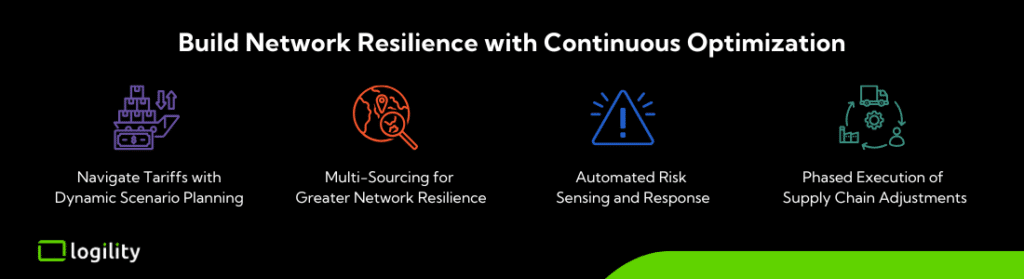
How to Build Network Resilience with Continuous Optimization

At Logility, we help companies build a continuously optimized supply chain network using AI, automation, and real-time scenario planning. Here’s how:

1. Navigating Tariffs with Dynamic Scenario Planning

Consider a U.S.-based automotive manufacturer sourcing aluminum from Asia. With new tariffs suddenly imposed on raw materials, the cost of production skyrockets. This isn’t just a pricing issue – these tariffs also threaten supplier viability, forcing the company to reassess its supplier contracts and sourcing strategy overnight.

Rather than making rushed supplier changes without analyzing broader implications or waiting until the next planning cycle to absorb increased costs, Logility’s continuous network optimization capabilities can help the manufacturer take immediate action, such as:

  • Simulate the impact of tariff changes on sourcing, transportation, and pricing before they happen
  • Identify cost-effective alternatives in seconds and adjust supplier agreements dynamically—and explore viable alternatives and adjustment.
  • Publish network changes to planning tools and phase change in with quantitative rigor

2. Multi-Sourcing for Greater Network Resilience

Suppose a consumer electronics manufacturer depends on a single-source supplier for semiconductor chips. When an unexpected geopolitical conflict halted exports, the entire supply chain came to a standstill, leading to costly delays and order backlogs.

Most companies would need to scramble to find an alternative supplier, delaying shipments by months and increasing procurement costs. However, the continuous network optimization approach enables a more optimized response, enabling the business to:

  • Diversify its supplier base in advance to ensure backup sources are available.
  • Monitor risk indicators – such as supplier financial health and geopolitical instability continuously
  • Adjust sourcing strategies automatically when disruptions occur to avoid downtime

3. Automated Risk Sensing and Response

Assume a global apparel retailer decided to shift some production from Southeast Asia to Mexico and Central America to shorten its lead times. However, without proper modeling, the move unexpectedly increased logistics costs and bottlenecked supplies as near-shore vendors struggled to meet demand.

The retailer has a choice to make – and the right one can be chosen by applying continuous network optimization tools to:

  • Compare cost and service impacts of nearshoring
  • Identify supply chain gaps and evaluate supplier readiness
  • Optimize transportation and logistics to ensure a cost-effective transition
  • Model for anticipated disruptions while having contingency plans for emergent disruptions

4. Phased Execution of Supply Chain Adjustments

Imagine a European pharmaceutical company caught off-guard by a new requirement to accelerate end to end product delivery times. Every decision in a supply chain has a ripple effect – switching suppliers or trade routes can disrupt inventory, forecasting, and fulfillment. However, the company lacked visibility into transportation emissions and supplier sustainability scores, increasing the risk of non-compliance penalties and damaging brand reputation.

By supporting continuous network optimization, Logility solutions can help the company:

  • Align distribution, inventory, and supply planning to prevent costly disruptions
  • Ensure every network adjustment is coordinated across all business units
  • Optimize supply chain flows in real time, without manual intervention
  • Adjust supplier selection based on sustainability criteria automatically
  • Ensure continuous compliance with evolving regulations, reducing penalties and risks

The Business Impact: Faster, Smarter, and More Resilient Supply Chains

Static supply chain planning is no longer viable. As disruptions, tariffs, and regulations accelerate, businesses must embrace continuous network optimization to stay competitive.

And with Logility solutions, you can too – leading to critical improvements such as:

  • 5-20% cost reduction through smarter overall network optimization
  • Increased resilience to pivot instantly in response to disruptions
  • Enhanced sustainability compliance with better emissions tracking
  • Remove latency in decision-making with AI-driven insights, reducing inefficiencies

Now is the time to optimize, adapt, and lead.

Ready to reimagine your supply chain?

Let's Chat