Short on Time? Here’s a Quick Summary

  • Demand forecasting models use historical sales, market signals and other relevant data to predict future customer demand and support planning decisions
  • Different demand patterns require different forecast models since seasonal, trend-driven and intermittent demand each behaves differently
  • Ensemble forecasting combines and weights multiple models to improve accuracy and reduce reliance on a single approach
  • Different accuracy metrics, such as mean absolute percentage error (MAPE), root mean squared error (RMSE) and mean actual error (MAE), reveal different types of forecasting error
  • Forecasts can degrade as demand patterns change, so continuous monitoring helps identify model drift and determine when adjustments are needed
  • Forecast Value add governance helps planners trust and trace forecasts through model versioning, audit trails and data governance

Introduction

Every supply chain decision starts with a question: What will customers need next? Get the answer wrong, and you could end up with excess inventory, production disruptions, missed sales or costly last-minute adjustments. That’s why accurate demand forecasting is so important to effective supply chain planning.

Demand forecast models use historical sales, market signals and external variables such as promotions, weather and macroeconomic conditions to predict future customer demand. But forecasting isn’t as simple as choosing a model and letting it run. Different demand patterns require different approaches, and forecasts can lose accuracy as market conditions change.
In addition, selecting the right forecasting model is only one part of the forecasting process. Forecasting systems must also determine the appropriate level of granularity, including which product, customers, channels or locations should be analyzed together. This is typically done using supervised learning (e.g., product categories, or unsupervised learning, e.,g., clustering techniques). When forecasts are generated for groups of products or customers, systems must also determine how to disaggregate higher level forecasts into the individual product level, while ensuring consistency across levels.

In this guide, we explore how demand forecast models work, how to evaluate their performance and why ensemble approaches can improve accuracy. We also look at how to detect model drift and structure forecasts so they remain reliable inputs for downstream planning decisions.n

Understanding Demand Forecasting Models

Most supply chains involve a range of products, each with its own demand pattern. These patterns can vary due to seasonality, promotions, campaigns or new product innovations that change demand for an existing product. As a result, different demand patterns may require different forecasting models to better predict when customers will place orders and how much they will buy.

Because demand patterns are so variable, forecasting systems rely on multiple model families to offer sales and operations teams a range of approaches to predict customer needs. Commonly used model families include autoregressive integrated moving average (ARIMA), exponential smoothing, tree-based machine learning (ML), and neural networks. The table below describes each model and provides some common use cases.

Model NameWhat It Does WellCommon Use Case
ARIMAIdentifies patterns in historical demand and uses them to predict future demandEstablished products with relatively stable demand and limited external influences
Exponential smoothingApplies exponentially decreasing weights to older observations to prioritise recent sales dataHigh-volume, fast-moving items with strong recurring seasonal patterns where recent sales history is the strongest predictor
Tree-based MLCaptures complex relationships between demand and factors such as pricing, promotions and holidaysProducts where external factors have a significant influence on demand
Neural networksIdentifies complex patterns and relationships across large amounts of dataLarge product portfolios with complex demand patterns and multiple demand signals

As you can see, no single model consistently performs best across all demand profiles. Each approach has strengths depending on the demand pattern and the data available for the model to ingest.

Why Use an Ensemble Approach?

Now that we’ve covered what demand forecasting models are and discussed some common model families, let’s turn to the important question: What is the right approach for your business?

Choosing a single “best” forecasting model for a product (or portfolio of products) isn’t straightforward and can create significant forecasting errors. Your teams may not know the underlying demand pattern, and even if they do, that pattern can change as customer behavior, promotions, seasonality and market conditions shift.

For example, a model that performs well for seasonal products where demand spikes predictably at certain times of year may perform poorly for intermittent-demand products such as spare parts. Similarly, a model that works well for near term forecasting may be less effective over the medium or long term. Applying the same forecasting approach across different demand patterns and time horizons could result in inaccurate forecasts, excess inventory or missed demand.

Modern forecasting systems can address these challenges by combining the strengths of multiple forecasting models, an approach known as ensemble forecasting. Rather than asking your planning team to determine which model will work best for every product or time horizon, the forecasting system can evaluate different approaches, learn from their performance and combine their forecasts. This can help smooth fluctuations in forecasts and incorporate information from multiple sources into the overall plan.

In the example above, an ensemble could combine forecasts from models that capture seasonal patterns with models that respond better to the irregular demand patterns of spare parts. It could weight different models according to how well they perform on the specific sales data and produce a more reliable and flexible forecast.
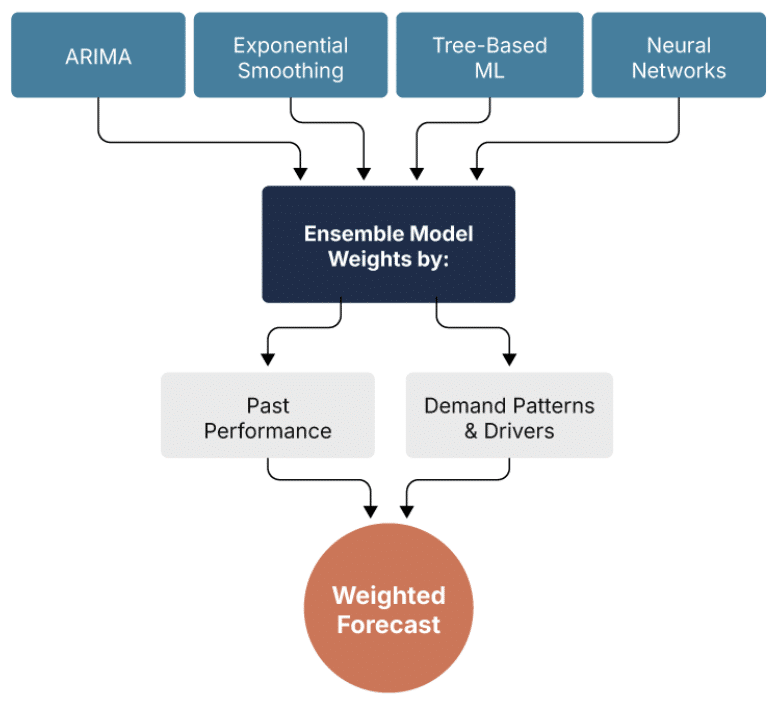
How ensemble forecasting works

The result is a more accurate forecasting approach that can adapt to different products and changing demand patterns while minimizing disruption for downstream supply chain or operational activities. For planners, that means better-informed decisions about inventory, production and procurement and less firefighting around excess inventory or missed demand.

How to Measure Forecast Accuracy

Producing a forecast is only part of the process. Once the models are in place, you need to know how well the forecast is performing and whether its errors could create problems downstream. Some common metrics used in this process include the following:

  • Mean absolute error (MAE) measures the average magnitude of forecast errors 
  • Root mean squared error (RMSE) heavily penalizes large, unexpected forecast misses
  • Mean absolute percentage error (MAPE) shows forecast error as a percentage of actual demand
  • Weighted mean absolute percentage error (WMAPE) measures percentage error while giving more weight to higher-volume or higher-value products
  • Bias shows whether forecasts consistently overestimate or underestimate demand

Connecting metrics to business context

Each of the metrics above has different strengths, weaknesses and purposes. MAPE, for example, treats over-forecasts and under-forecasts equally, so what may appear to be an acceptable MAPE value may actually exacerbate challenges with order fulfillment or distribution planning. Meanwhile, bias hides error magnitude because positive and negative errors cancel each other out. 

An additional aspect to consider is the forecast horizon over which accuracy, error and bias are measured. For example, if a production lead time is three weeks and the raw materials procurement lead time is two months, then the business should track forecast error over both three-week and two-month periods. Without this alignment, such blind spots can negatively impact customer experience and increase supply chain costs. 

It is important to understand how each metric fits into your overall business strategy. The metric that matters most depends on what you are trying to optimize for. Let’s take a look at a few scenarios:

  • If your biggest concern is overforecasting and excess inventory, bias can show whether you consistently forecast more demand than you actually see, e.g., performance by business unit. You can pair it with MAE to understand the typical size of those errors and, if needed, translate the excess units into inventory or working capital costs.
  • If large forecast misses are creating stockouts, capacity problems or service-level issues, RMSE can help highlight those unusually large errors by giving them more weight.
  • For high-volume products or mixed portfolios, MAPE and WMAPE can provide a useful view of forecast error as a percentage of demand. WMAPE can be particularly useful when you want higher-volume products to have a greater influence on the overall accuracy measure.
  • For low-volume or intermittent demand, MAE can provide a more meaningful view of forecast performance because percentage-based metrics such as MAPE can become unstable when actual demand is very small.

The goal is to connect forecast error to business consequences that matter most, whether that is customer service levels, working capital tied up in excess inventory, stockouts, capacity issues, or service levels. If you’re uncertain about which metric to choose for your use case, the decision tree below provides a helpful starting point.
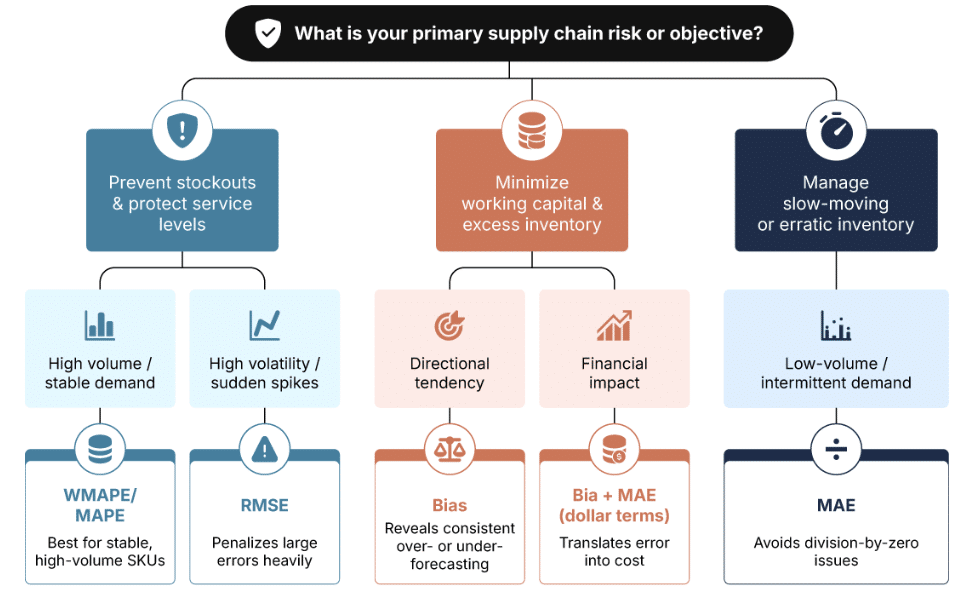
Demand forecasting metric decision tree

Finally, it’s important to define carefully which metric targets are considered “acceptable” for your business. For example, a 10% MAPE target is realistic for high-volume consumer products but unrealistic for low-volume spare parts. Set error thresholds based on the cost of being wrong and your service level commitment to customers.

How to Keep Forecasts Reliable as Demand Changes

Measuring accuracy tells you whether your forecast is working today. However, demand patterns are not static, and forecast accuracy may degrade over time. 

There can be several reasons for this. Market conditions shift, seasonality changes, or new competitors emerge, all of which can disrupt customer and consumer purchasing behavior. A model that performed well three months ago can appear to trend towards over-forecasting or under-forecasting. This is referred to as model drift, and each type of drift requires a different response.

How to Detect and Respond to Drift

Modern forecasting systems monitor for drift in real time by using approaches like tracking signal, MAPE trends and exception flags. They track metrics over rolling time windows to monitor any deviations from the expected range of metric values. When a tracking signal exceeds a threshold, an alert is sent to the forecast owner, who then checks the model or the underlying data. When systemic bias appears, the system can flag exceptions for planning teams to review. This early detection allows you to address changes in demand patterns before upstream and downstream systems are caught off guard and forced to react to unwelcome surprises.

When drift is detected, there are specific steps you can take to address it:

  1. Review the forecast assumptions to identify any material changes to how the assumptions were formed. 
  2. Validate that your input data hasn’t changed or degraded by checking for errors or inconsistencies. 
  3. Ensure that forecast drivers are still applicable. E.g., promotions, weather or new competitor information that may be used by the forecasting engine are still relevant and updated
  4. Evaluate whether model parameters need adjustment. In some cases, retraining the model on recent data will inform the model of demand pattern changes, and the model will determine which parameters need to be adjusted. The key is acting quickly when drift is detected to ensure supply chain impacts are minimized by demand pattern changes.

AI vs. Human Involvement

The question of how much to automate versus how much to leave to human review will depend on the behavior of the SKU, the capability of the system used to generate forecasts and the operating model and risk tolerance of the organization. Fully automated systems can flag drift quickly and take action to address it based on established rules and policies. However, human expertise is critical for understanding whether drift is a temporary anomaly or a more systematic challenge that requires model adjustment. 

Forecast governance should also measure forecast value added by comparing system-generated forecasts against a naive forecast baseline and evaluating whether human adjustments further improve forecast accuracy. The best approach combines system monitoring with human judgment, with clear guidelines to properly define the roles and responsibilities of humans and machines. Your forecasting system should alert you to drift, and humans should use their judgment as subject matter experts to determine if any intervention is needed to ensure demand forecast integrity.
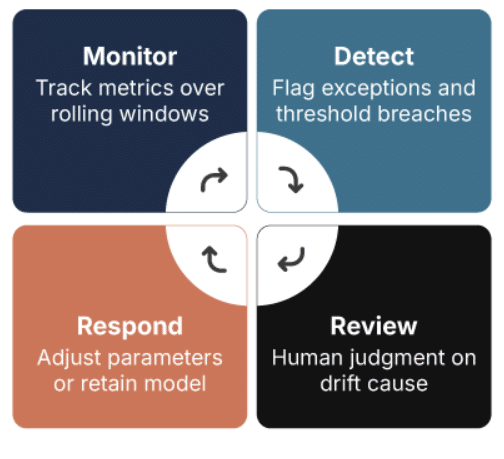
Detecting and responding to model drift

How Forecasts Flow into Planning and Decision-Makings

Once a forecast system generates a forecast, it must be structured for downstream use. A supply chain will conduct a consensus planning process where the various functions that have created forecasts will convene and agree on a combined forecast that will turn into the demand plan. Planners lead these sessions and capture from each functional area which model version produced their forecast and track the audit trails showing assumptions and parameters. 

Forecasts also flow into planning at different time horizons and aggregation levels:

  • Short-term forecasts (weeks to months) inform order fulfillment and inventory activity, like stock transfer orders and materials management
  • Medium-term forecasts (months to quarters) drive demand planning and inventory targets and are used to inform capacity planning decisions
  • Long-term forecasts (quarters to years) support sourcing strategies and supply chain network design configurations

Each time horizon may have different variables influencing the accuracy of a forecast, so you may use a set of models to create long-term forecasts, and another set of models as you move into the short-term.

To support this flow of information, forecasting systems must maintain clear versioning and data governance. Model versioning ensures that you can recreate past forecasts or roll back to a previous, more stable model if a newer model starts behaving erratically. Audit trails document forecast assumptions to enable root-cause analysis when a forecast does not achieve the intended result. Data governance ensures forecast data integrity by ensuring that historical data fed into the forecast models is clean, consistent and reliable. Together, these elements ensure that downstream teams build trust in the forecast and use it in their decision making and operational activities. 

Last thoughts

Demand forecasting models are not one-size-fits-all. Different SKUs, categories, and markets exhibit different demand patterns, and those demand patterns vary over time. Ensemble forecasting combines the strengths of multiple models to improve the forecast accuracy of the portfolio, and continuous monitoring for drift ensures forecasts remain reliable. 

The complexity of managing forecasts means that supply chains benefit from the use of technologies that evaluate multiple models to identify which is the best fit for an observed demand pattern. This eliminates the need for manual model selection, which has a tendency to be error-prone and time-consuming. The intelligence and consistency of demand forecasting technology is what separates an oversimplification of model creation from a rigorous exercise of ensemble model curation and automated drift detection.

Logility’s forecasting solutions incorporate ensemble approaches, automated model selection, and continuous monitoring. The Logility Supply Chain Management suite also includes DemandAI+, a purpose-built platform that supports supply chain digitization through an AI-first methodology. By using ensemble modeling and incorporating all drivers of demand, it goes beyond traditional forecasting by combining multiple models to deliver more accurate, tailored forecasts.

To see how your organization can partner with Logility and benefit from lower supply chain costs and higher customer service levels, contact us or request a demo.
Only Have a Minute? Here’s Our Key Takeaways:

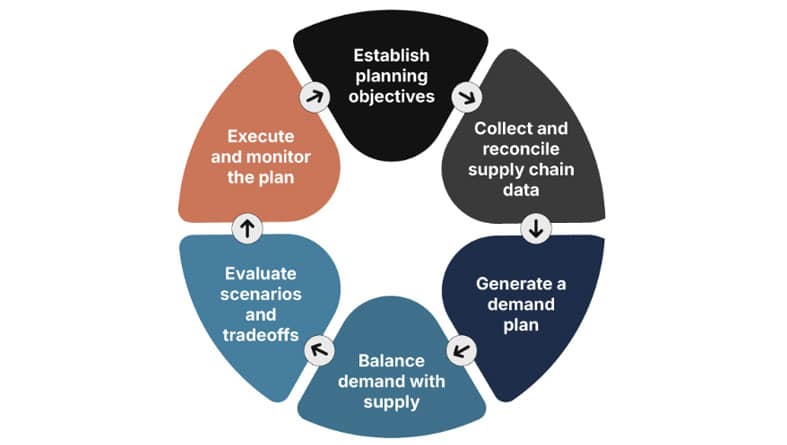
  • An effective supply chain planning process connects objectives, data, demand, supply and execution into a continuous cycle.
  • Reliable, reconciled data provides the foundation for accurate forecasts and better planning decisions.
  • Balancing demand and supply helps organizations identify gaps and constraints before they affect customer service.
  • Scenario planning helps teams evaluate trade-offs and choose the best response to changing conditions.
  • Continuous monitoring keeps plans aligned with actual supply chain performance as conditions change.
  • Artificial Intelligence (AI) can surface important signals, recommend actions and automate routine decisions within defined guardrails.

Introduction

Geopolitical trade tensions, wars, tariffs, port congestions, extreme weather events and cybersecurity issues are no longer occasional events. At the same time, customers expect faster, more personalized and more flexible fulfillment. Together, these factors push supply chains to stay responsive under conditions that used to be considered exceptional but are now common. Planning teams now need to reconcile shifting demand signals, supply constraints and inventory positions across systems that aren’t always built to talk to each other. Complexity is high, and setting up a strong supply chain planning process has become central to organizational performance.

The supply chain planning process gives your organization a structured, iterative way to balance demand and supply. It involves determining the optimal inventory position to meet customer demand while minimizing stockouts and overstock risks. When this process works effectively, you’ll see the benefits on your balance sheet and on the shop floor alike: fewer emergencies expedited, less cash tied up in inventory, better customer satisfaction and planning teams spending more time on meaningful decisions rather than firefighting around unexpected events.

In this article, you’ll learn how to structure an effective supply chain planning process in six key steps, from setting planning objectives through executing and monitoring the plan. You’ll also learn how AI-assisted planning platforms help you work faster, collaborate and focus on the decisions that matter most.

Supply Chain Planning Process Loop

Step 1: Establish Planning Objectives

Before starting any forecasting or data analysis, you need to decide what the supply chain planning process is trying to achieve. This means aligning finance, operations, logistics and key stakeholders around shared business objectives and the key performance indicators (KPIs) used to measure them. Many organizations formalize this alignment through a sales and operations planning (S&OP) cadence: a recurring cross-functional forum where these objectives are agreed upon and revisited as conditions change. 

Common KPIs include:

  • Service level: How consistently customer demand is fulfilled within the promised timeframe
  • Inventory turns: How often inventory is sold over a given period
  • Working capital: The amount of capital tied up in day-to-day operations
  • Cost to serve: The total cost of fulfilling customer demand, including transportation, warehousing, handling and other fulfillment costs
  • Forecast accuracy: How closely predicted demand matches actual demand over a defined period
  • Capacity utilization: How much of the available production or operational capacity is being used

These metrics provide a common ground for evaluating planning decisions and understanding the trade-offs between competing priorities.

In this phase, you should also define the scope and planning horizon. For the scope, you should specify which products, locations, business units, suppliers or marketplaces are included in the planning cycle. A clear definition of these boundaries helps ensure that planning decisions are evaluated against the right constraints. 

For the planning horizon, you may use different horizons for strategic, tactical and operational decisions. Planning cycles may range from months or years for network or capacity decisions to weeks or days for replenishment and production. The table below shows how planning horizons typically vary across operational, tactical and strategic decisions.

Decision TypeExamplePlanning Horizon
OperationalTransport planning, inventory deploymentDays
TacticalProcurement strategies, order consolidation, capacity managementWeeks-Months
StrategicNetwork optimization, business expansionYears

In short, longer horizons support higher-level decisions, while shorter horizons guide day-to-day execution.

Step 2: Collect and Reconcile Supply Chain Data

Once you’ve set your planning objectives, you need a reliable dataset to support the decisions that follow. Your planning process will typically rely on data from multiple systems, including:

  • Enterprise resource planning (ERP) systems
  • Spreadsheets
  • Supplier portals
  • Warehouse and transportation systems
  • Point-of-sale (POS) feeds

Relevant inputs from these data sources can include demand history, inventory position, supplier lead times, production capacity, purchase orders, customer orders, transportation constraints and network information.

Because these data sources often differ in structure and format, they rarely give you a consistent and reliable picture of the end-to-end supply chain. Common issues include:

  • Differences in product and location hierarchies between systems
  • Inconsistent units of measure
  • Missing, duplicated or outdated item codes

These are likely reasons why your team spends a significant amount of time reconciling spreadsheets and resolving discrepancies before they can begin analyzing the plan. Bringing this data together into one consistent and trusted dataset is often the most tedious and time-consuming part of the planning cycle. It’s also critical to get this right: if the issues are carried forward into the planning process, they can distort forecasts, create false constraints or lead you to make decisions based on outdated or wrong information.

Step 3: Generate a Demand Plan

Once you have a reliable, clean dataset, the next step is to develop a demand plan that estimates what customers are likely to purchase over the planning horizon. You can build this plan by:

  • Building a statistical baseline forecast from historical demand, using methods such as moving average or exponential smoothing
  • Incorporating machine learning to identify patterns across larger datasets and account for factors such as seasonality, product lifecycles and changes in demand behavior
  • Accounting for known future events and demand drivers such as promotions, product launches, pricing changes and market conditions
  • Identifying outliers, such as unusual spikes or drops in historical demand, that can distort the baseline forecast if treated as representative of future demand; rather than simply removing these observations, you should investigate their underlying causes and determine whether they are likely to recur

You should then review the resulting forecast with the stakeholders who have relevant market and customer knowledge, as sales, marketing, finance and supply chain teams may have information that is not captured in historical data. Combining the statistical forecast with these inputs helps establish a demand plan that you can use as a common planning assumption.

Step 4: Balance Demand With Supply

With an agreed demand plan in place, you can now compare expected requirements with what the supply chain can realistically support. This means accounting for service level targets, inventory availability, production capacity, supplier lead time, material constraints and other operational limitations. The goal is to identify potential supply gaps, surpluses and bottlenecks before they affect customer service.

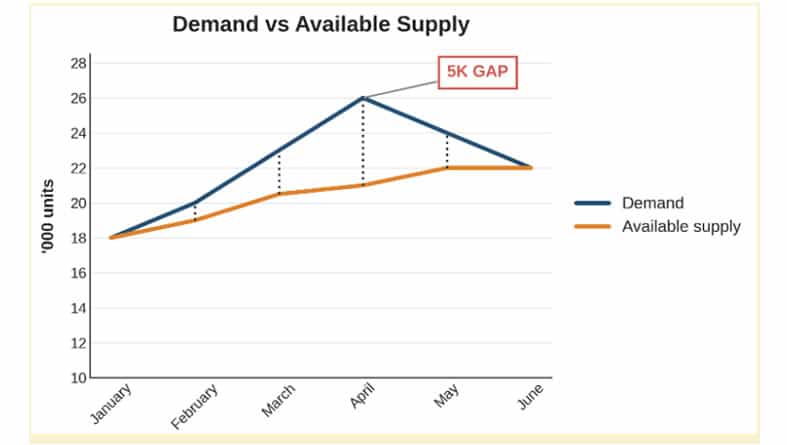
For example, the figure below indicates that in the month of April, a product will require 26,000 units, while available inventory and planned production can cover only 21,000 units.

Balancing Supply and Demand

That 5,000-unit gap could be caused by:

  • Insufficient production capacity
  • A supplier constraint
  • A longer-than-expected lead time
  • Inventory positioned in the wrong location

At this stage, the goal is to understand where the plan is infeasible and why. You can then identify potential responses, such as adjusting production schedules, bringing purchase orders forward, reallocating inventory, changing sourcing decisions or re-prioritizing demand. These alternatives should be evaluated against the planning objectives and KPIs established earlier.

This analysis gives you a baseline plan that shows where demand and supply are aligned and where intervention may be required.

Step 5: Evaluate Scenarios and Trade-offs

Once you’ve identified potential gaps between demand and supply, you need to determine how best to respond. There is rarely a single solution. A shortage at one location, for example, could be addressed by:

  • Sourcing from an alternative fulfillment center
  • Reallocating inventory from another location
  • Changing a production schedule
  • Expediting shipment
  • Using an alternative supplier

Each option can resolve the immediate constraint, but it can also create consequences elsewhere in the supply chain. Scenario planning allows you to evaluate these alternatives before committing to a course of action. You can change assumptions or constraints, such as supplier capacity and transportation routes, and assess how each scenario affects the overall plan. For example:

  • Expediting a shipment might protect the service level but increase transportation costs and, as a result, reduce margin
  • Reallocating inventory could avoid a stockout in one market but create a shortage in another
  • Shifting production to resolve capacity constraints could increase changeover costs

The key is to evaluate the objectives established at the beginning of the planning process. Comparing these effects across relevant KPIs helps you see the full implications of each decision.

Step 6: Execute and Monitor the Plan

Once you’ve selected and approved a scenario, you need to translate the plan into operational actions. These can include:

  • Releasing production schedules
  • Generating, adjusting or expediting purchase orders
  • Allocating inventory
  • Booking transportation
  • Updating distribution plans

The execution stage is where planning decisions begin to affect actual supply chain performance, so it’s important to maintain visibility into how the actual results compare with the original assumptions.

Monitoring performance creates a feedback loop for the next planning cycle. If actual demand, inventory, production or supplier performance diverges from the plan, you can identify exceptions and reassess your decisions. AI can support this process by helping identify exceptions, recommend actions and automate routine decisions within predefined guardrails. For example, you could establish rules for:

  • When inventory should be replenished
  • When a supplier should be considered for an order
  • When a shipment should be rerouted

If conditions fall within those limits, an AI-enabled system can execute the decision automatically. If a decision has a larger financial, operational or customer impact or falls outside those guardrails, the system can flag it for your review. 

The result is a continuous planning and execution loop rather than a linear process that ends when a plan is released. As conditions change, new information can feed back into the process, allowing you to retain control over complex decisions that require business context or human judgment while automating routine and repeatable decisions.

Turning Planning into Continuous Improvement

An effective supply chain planning process gives you a way to connect planning decisions from one stage to the next. Reliable data supports better forecasts, better forecasts provide a stronger basis for balancing supply and demand, and scenario analysis helps you choose how to respond to potential gaps. Actual results from execution provide new information that feeds back into the next planning cycle. When planning is connected across demand, supply, inventory and execution, organizations can respond to change faster while continuously improving their plans.

The right planning technology can help you:

  • Anticipate disruptions: Monitor changing demand, supply and market conditions to identify potential issues early and evaluate alternative responses
  • Continuously refine plans: Incorporate new data and execution results into the planning cycle so plans stay aligned with current conditions
  • Make better decisions faster: Use AI-assisted planning to identify signals, evaluate scenarios, recommend actions and automate routine decisions within defined business rules

Logility Supply Chain Management brings these capabilities together. Its solutions connect demand planning, supply planning, inventory optimization, S&OP and scenario analysis within a unified planning environment. These solutions can help your team move from identifying a potential issue to evaluating options and taking action more quickly and effectively. The result is not simply a better plan but a continuous, iterative learning process that adapts as conditions change, learns from execution and turns new information into better-informed decisions.

Ready to see what that could mean for your organization? Request a demo or contact us to start the conversation.

What You’ll Learn

Supply chains generate more data than ever, but data alone won’t help you act faster. In this blog, you’ll learn how AI agents connect signals across your business, improve decisions and turn insights into action. You’ll explore the following:

  • How agents help detect disruptions earlier by continuously monitoring demand, supply, inventory, production, logistics and external market signals.
  • How you can use AI agents to keep demand, supply, inventory and production plans aligned as conditions change.
  • How agentic AI coordinates actions across different enterprise systems.
  • Why AI governance matters and how guardrails, human oversight and explainable decision-making support responsible AI.
  • Best practices for building an AI-ready supply chain, from creating a strong data foundation to choosing a purpose-built platform.

Introduction

For years, businesses have poured money into getting better data, dashboards and forecasting tools, but most organizations still find themselves reacting to disruptions rather than staying ahead of them. The core problem often isn’t a lack of information; it’s what happens after that information arrives.

In response to these challenges, artificial intelligence (AI) is becoming embedded across every layer of the supply chain, from sensing and forecasting to execution. AI agents in the supply chain help cut through the noise by continuously monitoring disruption signals, surfacing the most important insights and turning them into actions that can be executed across supply chain systems in near real time. The power is not only in making better decisions but reducing the decision latency and acting as the speed of opportunity. 

In this blog, we examine each layer of the supply chain process and how agentic AI can play a role at key stages.

Overview of AI Agents in the Supply Chain

Before diving into how AI agents can provide practical value for your business, let’s define what they are, how they differ from other technologies that come up in conversations about AI and how they operate within the supply chain.

AI agents are action-takers. Think of them as digital coworkers that execute complex workflows with a degree of autonomy. For example, an AI agent might:

  • Detect that a supplier delay will create an inventory shortfall
  • Evaluate alternative suppliers and available stock
  • Recommend an appropriate response
  • Automatically update purchase orders or replenishment plans within predefined business rules

What makes this AI agentic is the ability to move from insight to action across multiple steps and systems. An AI agent can gather information; reason about what to do next; use tools to interact with systems such as your enterprise resource planning (ERP) system, warehouse management system (WMS) or transportation management system (TMS); and adjust its actions as conditions change.

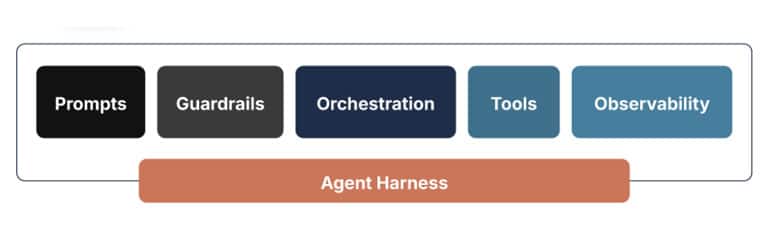
This autonomy doesn’t mean operating without oversight. To work reliably and safely at scale, AI agents must operate within a carefully defined harness, which brings together the components required to govern their actions:

  • Prompts that define the agent’s persona, purpose and style 
  • Guardrails that define what it must never do or when to request approval
  • Orchestration that coordinates multi-step workflows and handoffs 
  • Tools that take actions like sending emails or querying a database 
  • Observability that monitors the agent’s step-by-step actions 

With these components in place, the harness helps determine what an agent can do autonomously, when it needs human approval and how you can monitor and audit its actions.

The components of an AI agent harness used for governance

How AI Agents Connect Supply Chain Signals

Before we examine specific use cases for AI agents in the supply chain, let’s look at another example that illustrates how AI agents can connect signals that would otherwise remain siloed.

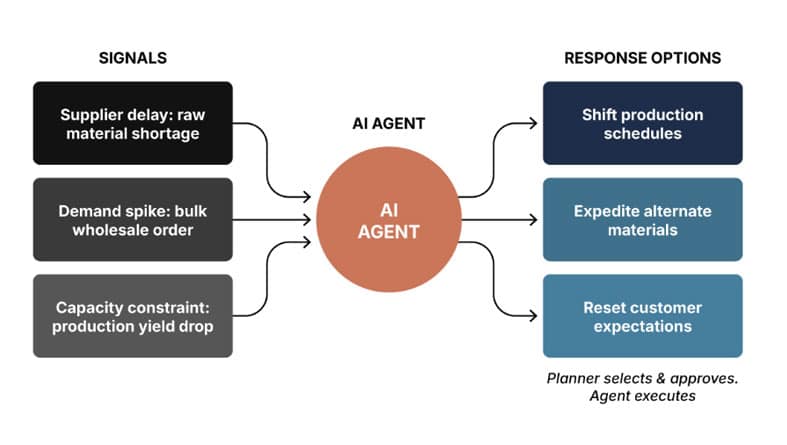
Imagine that a key overseas supplier for your organization flags a shortage of raw materials that will delay production. At the same time, a large wholesale customer submits a bulk order well above its usual volume, hoping to lock in current pricing before an expected increase. Meanwhile, the yield on a production line for that product has drifted down for four shifts. Together, these events create three signals: one that impacts supply, one that impacts demand and a third that hits capacity. Collectively, they put fulfillment and work orders at risk.

In a traditional operation, these signals remain disconnected: Procurement reviews the supplier delay, sales enters the order, and the plant works on the yield issue locally. The three parties meet at next Tuesday’s planning review, by which point the decision window has closed. Because signals converge on a weekly cadence while the situation moves in hours, no party is able to respond proactively. 

The gap usually isn’t a lack of data. It’s that the data is disconnected and the system is unable to support action. Most organizations already run ERP, WMS, TMS, manufacturing execution systems (MES), quality management systems (QMS), customer relationship management (CRM) and supplier relationship management (SRM) solutions with the necessary data in place. So the data already exists somewhere in the stack, but it’s not wired to a response.

By contrast, when AI agents operate effectively across connected supply chain systems, these signals can be evaluated together. The delay is matched against open orders, the new demand is checked against capacity, and the conflict becomes a real-time decision point of whether to shift production schedules, expedite alternate materials or reset customer expectations. The AI recognizes that the bulk order may represent demand pulled forward rather than newly created demand, since the customer’s annual volume is already committed. It factors that context into several response options, each showing the impact on margin, expedited freight, capacity and on time in full (OTIF) delivery rate. The planner chooses the best course of action; once approved, the agent executes it.

AI agents connect signals across supply, demand and production

This is one example of how AI agents can reshape supply chain operations. They don’t replace planners and analysts—they evaluate signals across systems and turn them into coordinated decisions and actions.

Examples of AI Agents in the Supply Chain

AI agents can take on distinct roles depending on where they sit in the supply chain. The sections below walk through four key areas where agentic AI is already changing how work gets done, from sensing disruptions to managing inventory in real time.

Environmental Sensing

Environmental sensing is the continuous collection and interpretation of signals from across the business and the outside world that affect an organization. Modern AI solutions bring these signals together in real time; helping you understand what’s happening now; identifying emerging risks and opportunities; and acting before risks become business-critical. The table below lists common signals for environmental sensing.

CategoryExample DataWhat It Signals
Macroeconomic indicatorsInflation rates, interest rates and GDP trendsDemand environment and purchasing power shifts
Geopolitical signalsSanctions, tariffs, trade restrictions and port closuresSupply disruption risk and trade flow constraints
Weather and climate dataHurricanes, heat waves, drought and stormsShort-term disruption risk to supply, production, inventory, transportation and demand
Transportation and logistics conditionsPort congestion, freight rates, carrier capacity, shipment delays and ETA varianceNetwork bottlenecks, transit delays and fulfillment reliability
Commodity and input pricingOil, steel, grain and semiconductor pricesCost pressure and upstream supply volatility
Market signalsSocial media trends, search trends, reviews, competitor pricing, promotions and product launchesEmerging demand shifts, preference changes and competitive pressure
Regulatory changesLabor laws, emissions rules and import/export policyStructural cost and supply chain constraint changes

On their own, these signals aren’t actionable. The data points are nice to know, but the volume, formats and origin are difficult for a human team to monitor, interpret and act on manually. AI changes what’s possible in a few ways:

  • Continuous, automated monitoring flags meaningful shifts the moment they emerge
  • Pattern recognition separates real trends from ordinary variability
  • Cross-system correlation connects a signal in one system (e.g., a supplier’s late shipment) to its downstream effect in another (e.g., production schedule risk)
  • Contextualization and prioritization help teams focus on the signals that matter most and understand the potential business impact

Supply chains have become much harder to predict because post-pandemic changes, geopolitical volatility, rising energy costs and more frequent climate-related events are pushing risk to new levels and demanding faster, more adaptive responses. AI agents built for environmental sensing give you a way to continuously understand what is changing around and within a supply chain, empowering your organization to anticipate risk, identify opportunities and act before disruptions become business-critical.

Becomes Continuous Planning

Once changing conditions and potential disruptions are identified, planning turns that awareness into a coordinated course of action across demand, supply, inventory and production. Traditionally, planning has been a slow, sequential and functionally disconnected process: Demand planning happens, supply planning reacts, and production plans around the resulting constraints, often on a weekly or monthly cadence.

AI agents make planning more adaptive in several concrete ways:

  • Plans are continuously rebalanced as new demand, supply and capacity information becomes available
  • Planning decisions stay synchronized across demand, supply, inventory and production so that every function works from the same assumptions
  • Dynamic scenario modeling lets planners simulate what-ifs and weigh tradeoffs across service, cost, capacity and inventory
  • AI agents identify emerging tradeoffs, recommend adjustments and help teams move from analysis to action faster

Rather than being a periodic, disconnected process, planning becomes a continuously updated, system-wide function that aligns decisions with current conditions and business objectives, enabling organizations to adapt plans as conditions change.

Production and Logistics Execution

AI agents change execution from a process involving fixed schedules and rules to a practice of continuous, real-time optimization. Instead of waiting for manual intervention, they respond to live conditions and adjust decisions as conditions change. 

That means execution becomes adaptive across production and logistics. In production, it connects shop-floor signals such as machine performance, labor capacity and quality data directly to supply chain decisions so that schedules adjust to real constraints and issues get caught early. In logistics, it optimizes the movement, storage and delivery of goods from suppliers to customers based on signals such as transportation constraints, carrier performance and external conditions. This might mean shifting warehouse workloads or picking different carriers based on cost, speed and capacity tradeoffs.

Across both domains, AI-driven orchestration can push decisions directly into the operational systems that run day-to-day work—ERP, WMS, TMS, MES and beyond—so a decision doesn’t stall as a recommendation nobody acts on. The result is execution that behaves less like a rigid plan and more like a live optimization system. Instead of just carrying out instructions, the system reviews and fine-tunes operations to improve efficiency, reduce waste and make better use of assets as conditions evolve.

Dynamic Inventory Management

Inventory sits at the intersection of every other function. This is where demand volatility, supply delays and production changes all show up as either excess stock or stockouts. Getting it right has always been a balancing act, and traditional inventory management tends to rely on static safety-stock rules and periodic reviews that lag behind actual conditions.

Agentic AI uses a more dynamic approach. Safety stock and reorder points are continuously evaluated and adjusted as demand, supply, lead times and other conditions change. Inventory gets right-sized by location and position, determining not just how much to hold but also where to store it based on demand while minimizing cost and risk. The system responds faster to shifts in demand and supply while continuously improving recommendations based on forecast accuracy, actual demand patterns and changing conditions.

Done well, this is where some of the most measurable AI-driven gains show: lower carrying costs, fewer stockouts, improved service levels and inventory that’s positioned where it’s actually needed rather than where it happened to land.

Building a Strong, Connected Data Foundation for AI Agents

AI agents are only as good as the data they operate on. An agent deciding how to respond to a supplier delay, for example, may need to evaluate supplier lead times from your ERP, current inventory from your WMS, production capacity from your MES and open customer orders from your CRM. If that data is incomplete, inconsistent or difficult to reconcile across systems, the agent may lack the context it needs to make a reliable decision.

One of the greatest challenges is ensuring that all information is accurate and structured consistently enough for AI agents to interpret it correctly. To prepare data for AI agents’ use, focus on four core practices:

  • Cleansing: Removing errors, duplicates, missing values and inconsistent formatting (e.g., “St.” vs. “Street”).
  • Standardization: Putting data into consistent formats, units and structures so systems and models can identify and compare datasets.
  • Deduplication: Identifying and merging records that refer to the same entity but were entered or captured incorrectly.
  • Bias detection: Reconciling demand history to remove the effects of stockouts, promotions or one-time disruptions so that models learn true demand patterns rather than distorted signals.

None of this is one-time work. As data, business conditions and agent performance evolve, continuously monitor outcomes, validate results against real-world performance and refine the data and logic your agents rely on.

Governing AI Agents

As AI agents take on a larger role in supply chain decisions, governance becomes a critical concern. The goal is to give agents enough autonomy to be useful while maintaining clear boundaries around what they can access and do.

Start by defining which decisions an agent can make independently and which require human approval. For example, an agent might shift a production run to another line to absorb a small demand spike on its own but require sign-off before pulling forward an entire production schedule. These rules become part of the guardrails that keep agents operating within acceptable business limits.

You also need visibility into how agents perform. Track the data they use; the recommendations and actions they make; and the outcomes that follow so your teams can identify errors or declining performance early. In addition, because agents may access sensitive supplier, pricing and cost data, limit their access to only the systems and information they need.

Most importantly, formalize these controls through an AI governance framework. Aptean’s 2026 Artificial Intelligence Research found that while 96% of leaders say a formal governance framework is necessary to use AI safely, 37% haven’t built one, and 75% cite that gap as a major barrier to AI success. 

Building this sort of framework takes time and iteration. Start with the following steps:

  • Document each agent’s purpose, the data and systems it can access and the actions it is authorized to take
  • Assign clear ownership so someone remains accountable for each agentic system’s performance
  • Establish risk-based approval processes that apply greater scrutiny to higher-impact agents and decisions
  • Train employees on how agents should be used, where their limitations lie and when human judgment is required

While it isn’t possible to eliminate every possible risk, an AI governance framework puts practical controls around how agents operate and creates accountability for their actions.

How Logility Turns Insight Into Action

As we have discussed, the technology to sense, plan and act on supply chain signals in real time already exists. What separates high-performing supply chains from the rest isn’t more data or more dashboards. It’s the distance between what your organization knows and what it does about it.

Working with a trusted partner can help.  Logility Supply Chain Management provides a suite of tools to help you integrate AI agents into the systems and workflows your teams already use with the right data, prompts, guardrails and tools behind them. This includes:

  • DemandAI+: AI-powered demand planning and forecasting with prebuilt agents that can retrieve historical data, identify emerging trends and flag opportunities to improve forecast performance.
  • Orchestration Center: An agentic AI orchestration layer that connects supply chain systems, assesses the downstream impact of disruptions and coordinates responses across planning, production and fulfillment.
  • Human-guided automation: Logility’s approach allows teams to maintain oversight of AI-driven actions, with agents able to execute approved actions within defined policies and guardrails.
  • These capabilities illustrate how AI agents can help supply chain teams identify issues, evaluate potential responses and take action faster while keeping humans involved in important decisions.

Together, these capabilities provide a practical path to deploying properly configured agents without requiring your teams to build the underlying AI capabilities from scratch.

For more on how Logility’s solutions can work for your business, request a demo or contact us to start the conversation.

Short on Time? Here’s What You Need to Know

According to a market study by Mordor Intelligence, the global cloud supply chain management market will reach $30.56 billion by 2031, growing at a compound annual rate of nearly 17%. Here’s how the right platform can satisfy this growing demand inside your organization:Key Takeaways 

  • Prebuilt integrations, data quality checks and real-time synchronization help your teams plan from current, consistent information.
  • Rolling scenario planning and elastic capacity help you respond to disruption and changing workloads without infrastructure holding you back.
  • Security, governance and compliance capabilities help you protect your planning data and meet business and regulatory requirements.
  • Cloud-based access connects your teams, sites, suppliers and customers to the information they need to make better decisions. 
  • A connected and flexible cloud platform is an important prerequisite for adopting artificial intelligence (AI) and other emerging technologies.

Introduction

Learn how cloud-based supply chain planning software connects data, scales resources and supports smarter organizational decisions.

Many companies are moving away from on-premise planning systems and toward cloud-based platforms, and it’s easy to see why. The capital cost of maintaining server infrastructure adds up fast, and that’s before you factor in the limited scalability you get without new infrastructure investment.

On top of that, on-site systems frequently struggle to deliver live data, pushing management teams into reactive decision-making and firefighting rather than proactive planning. Legacy architecture also makes it difficult to integrate new technology as it emerges, leaving you behind unless you can afford to update your infrastructure. Together, these issues create a bottleneck that slows planning when speed matters most.

Cloud-based supply chain planning software can improve business processes in several key ways. For example, cloud software can:

  • Streamline how you connect planning data, expand resources and give your people access to plans across locations and organizations. 
  • Allow your organization to focus on running a business rather than on building and maintaining compliant and secure software architecture.
  • Provide a foundation for adopting AI and other emerging technologies without rebuilding your underlying planning environment.

In this article, we discuss how cloud-based planning works, what to assess before migrating and which capabilities to evaluate when selecting a platform.

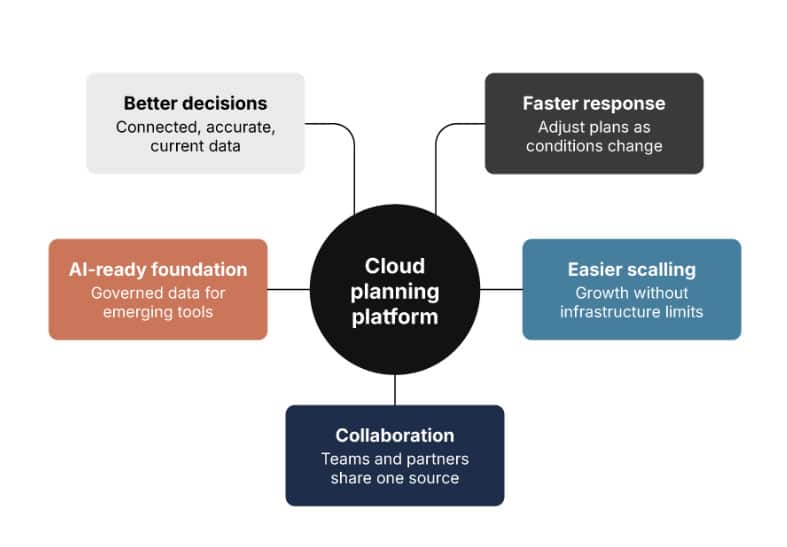
What cloud-based supply chain planning software can deliver

How Should You Prepare for Cloud Migration?

Before evaluating software options, the more foundational step is taking the time to audit your current planning process as it actually operates today, not as it’s documented to operate. We suggest the following five steps:

  1. Map your data sources: Identify all systems, spreadsheets, artifacts and groups that supply planning data or influence planning decisions.
  2. Identify manual workarounds: Find where data is exported, cleaned or manually reconciled to pinpoint the biggest opportunities for automation.
  3. Find recurring data errors: Ask the people responsible for reconciliation which fields cause the most frequent problems and how they’re currently resolved.
  4. Document update frequency: Record how often each source is refreshed to determine where more frequent updates could support continuous planning.
  5. Identify missing information: Look for data, inputs or planning considerations that are missing from the current process but should be part of a holistic planning approach.
  6. Assign ownership: Identify who is accountable for each data source and planning activity so you can address gaps or ambiguous responsibilities.

Performing this type of audit before implementing a new system avoids automating an already broken process “as is” and gives you insight into how to clean things up before rolling out a new system.

How Does Cloud-Based Planning Connect Your Data?

Once your organization is ready to migrate, one of the first questions is how you’ll bring your data together. Your plans are only as reliable as the information behind them, but how can you reconcile information scattered across enterprise resource planning (ERP), warehouse management systems (WMS) and transportation management systems (TMS) that weren’t designed to communicate with each other in real time, if at all?

Instead of relying on spreadsheets or other manual workarounds, your supply chain planning software should do the heavy lifting. It should quickly and reliably connect, standardize, validate and update data across the supply chain through two core capabilities: templated connectors and built-in data quality checks.

Prebuilt, Templated Connectors to ERP, WMS and TMS Systems

Templated connectors are prebuilt, ready-to-use integration links between two systems (like an ERP and WMS) that come with the data mapping and configuration already built in. When a system uses templated connectors, it reduces the need for custom, point-to-point integration work that stretches out implementation timelines, adds a risk of data not migrating properly and lacks standardization.

Templated connectors can also ease the ongoing burden of maintaining integrations. For example, they can help your organization:

  • Reduce the total cost of ownership: Vendor-maintained connectors shift the ongoing maintenance burden from your internal information technology (IT) team to the vendor, which reduces lifecycle costs beyond just the initial implementation
  • Maintain data consistency at the source: Standardized mappings help maintain consistent definitions for fields such as units of measure (UOM), stock-keeping unit (SKU) hierarchies and lead times across systems
  • Lower technical barriers for adoption: Your team can configure connector mappings with less IT team involvement, making it easier to onboard new sites, business units or acquired entities

Built-In Data Quality Checks During Integration

Connecting systems doesn’t automatically make the data reliable. If required fields are missing, SKUs are duplicated, or units of measure are inconsistent, those problems can undermine the plans built from that data. Garbage in, garbage out, as the expression goes.

Built-in data quality checks address these issues at the source rather than letting problems surface downstream where they’re more expensive to trace and fix. This can provide several benefits:

  • Protecting data integrity by flagging missing fields and catching errors in UOM, duplicate SKUs and duplicate suppliers
  • Shortening implementation by reducing manual validation and the human error that comes with it
  • Building organizational trust in the data and plans within the system
  • Turning data quality into an ongoing discipline rather than a one-time cleanup effort

However, before built-in checks can add value, your organization first needs to define what good data looks like and who is responsible for maintaining it. For example, supply chain, IT and finance may each have different priorities for master data. Procurement may need specific supplier fields to be complete, while demand planning may depend more heavily on product hierarchies and historical demand data. Establish these rules as a cross-functional effort to ensure that the system is checking for issues that actually affect business decisions.

You’ll also need to determine who resolves an issue once it’s flagged. Assign an owner to each major data domain, and establish a timeframe for resolving exceptions. As an example, the supply chain team might own supplier data and have one week to address flagged issues.

When these practices are implemented, they prevent data-quality exceptions from becoming an endless queue of IT tickets and allow data quality checks to fulfill their ultimate purpose: keeping planning data accurate and actionable over time.

How Can a Cloud Platform Help You Plan and Adapt?

Connected, accurate data only creates value if your team can act on it quickly. A cloud-based planning platform can help you continuously adjust plans as conditions change while scaling to support growth. The table below highlights four cloud capabilities that make this possible.

Without a cloud platformWith a cloud platform
Batch, infrequent updatesContinuous recalibration
Static plans, limited alternativesRolling scenario planning
Infrastructure limits growthElastic capacity scales with demand
Stale snapshotsReal-time data synchronization

Let’s take a look at each of these capabilities in greater depth.

Continuous Recalibration

Continuous recalibration can help limit the bullwhip effect by making smaller adjustments based on current conditions rather than reacting to outdated, batched signals. For example, if a retailer sees a 10% demand increase during a two-week promotion, a distributor with infrequent planning cycles may mistake that temporary spike for sustained growth and increase orders accordingly. 

By contrast, a cloud-based system with continuous recalibration could capture the demand signal, account for its timing and context, and dynamically calibrate its downstream impact across the supply chain. Planners can then adjust orders more proportionally to reduce the risk of excess inventory.

Rolling Scenario Planning

Rolling scenario planning helps your team determine how to respond when the right course of action isn’t immediately clear. As conditions change, you can model alternatives such as:

  • Treating the increase as promotional: Adding a modest buffer and planning for demand to return to baseline after the promotion
  • Planning for sustained growth: Increasing supply more aggressively in case the promotion leads to lasting demand
  • Holding and monitoring: Avoiding major changes and reassessing as additional data becomes available

AI can make this process more dynamic. It can help planners identify relevant scenarios, surface variables that could affect outcomes and compare potential plans against business objectives. Choose a tool that can use current supply chain data to identify meaningful scenarios, explain the assumptions behind them and keep recommendations aligned with your organization’s planning objectives. Your planners can then evaluate the trade-offs between scenarios and decide how to proceed.

Scalability and Elastic Capacity

Business growth doesn’t wait for infrastructure to catch up. If your system can’t support potential growth without infrastructure investment and new implementations, you’re limiting your ability to grow. 

Cloud-based solutions have the ability to flex with business growth, seasonal product launches and acquisitions without requiring new software infrastructure. That flexibility can help you take on larger planning volumes or more complex scenarios without making infrastructure capacity a constraint on business decisions. It can also reduce the need for major infrastructure projects when planning requirements change or when integrating AI capabilities.

Real-Time Data Synchronization

Static snapshots can only tell you so much. If a production schedule changes five minutes after your last refresh, your plan may already be out of date.

Real-time synchronization keeps your planning data current as conditions change. Look for tools that automatically synchronize data across systems, such as ERP, WMS, TMS and manufacturing platforms. In addition, the tool should easily connect external data, such as point-of-sale, competitor or customer information, to your planning process.

What Makes a Cloud Platform Enterprise-Ready?

As you extend planning across teams, locations and external partners, broader access also creates new requirements around security, collaboration, and the ability to keep up with emerging technologies. As you evaluate platforms, pay particular attention to security and governance, collaboration and support for emerging technologies.

Security, Governance and Compliance

Security is an important consideration when comparing planning platforms, whether cloud or on-premises. The cost and complexity of different approaches depend on factors such as your provider, architecture, existing IT capabilities and regulatory requirements. 

With a cloud platform, the provider maintains the underlying security infrastructure while your organization remains responsible for evaluating whether its controls meet your requirements. Look for relevant security certifications, granular role-based access controls and built-in audit trails. 

Specifically, role-based access controls should allow permissions to be defined at different levels, such as by module, data field, transaction type or business unit. Audit trails should provide visibility into who changed what and when, giving your team a documented record when you need to investigate changes or support an audit.

Shared Access and Collaboration

A connected cloud environment should also provide the foundation for adopting AI and other emerging capabilities. Rather than building new infrastructure each time you want to introduce a new technology, a modern cloud platform can make it easier to integrate new capabilities with the systems and data you already have in place. That flexibility can help your organization adopt new tools as they become available while keeping planning information connected and governed.

What Are the Benefits of Cloud-Based Supply Chain Planning?

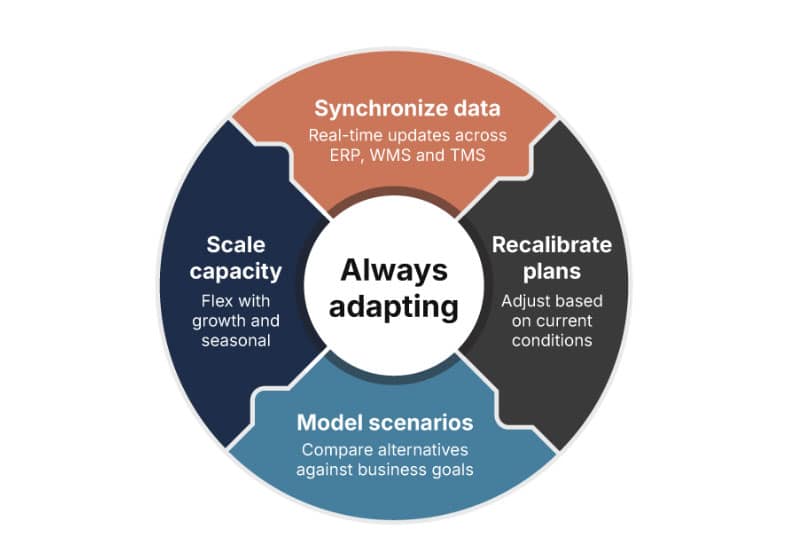
We’ve now discussed several capabilities and benefits of effective cloud-based supply chain planning software. Together, they create a continuous planning cycle that helps your organization stay responsive as conditions change. To summarize, an effective solution can help you:

  • Synchronize data: Bring together current information from across your supply chain so that your teams can plan from a connected, accurate source of data
  • Recalibrate plans: Adjust plans as demand, supply and other conditions change rather than waiting for the next planning cycle
  • Model scenarios: Compare alternatives and evaluate trade-offs to determine how different decisions could affect your business objectives
  • Scale capacity: Flex with growth, seasonal demand, new locations and changing workloads without making infrastructure a constraint
  • Collaborate more effectively: Give internal teams and external partners access to the planning information they need to coordinate decisions
  • Prepare for AI and emerging technologies: Build a connected cloud foundation that makes it easier to integrate new capabilities as they become available

In short, the right cloud-based planning platform can help your team move from static, periodic planning to a continuous cycle of synchronizing data, recalibrating plans, modeling scenarios and scaling capacity as your business changes.

The continuous planning cycle

Working with a Trusted Partner

Ultimately, realizing the advantages of cloud-based planning hinges on careful preparation, choosing the right platform and continuing to evolve your implementation strategy. While the process can seem daunting, leaning on the expertise of a trusted partner can help.

Logility Supply Chain Management brings prebuilt integrations, continuous scenario planning and enterprise-ready security together in a single cloud platform, backed by a team that understands the industries you operate in. Its solutions can be configured to meet your organization’s needs from planning and sourcing to inventory optimization and fulfillment. Its capabilities also provide a foundation for incorporating AI into planning and decision-making as your needs evolve.

Ready to see what that could mean for your organization? Request a demo or contact us to start the conversation.

IDC CSAT AWard

Aptean awarded IDC’s 2026 SaaS Supply Chain Management Customer Satisfaction Award

Nearly 2,900 companies rated the supply chain software they use every day. Aptean placed in the highest-scoring group.


Aptean Scores Above the Supply Chain Average With Customers

Customers rated Aptean above the category average on how well the software fits their industry, how it connects to their other systems, and what it’s like to work with Aptean years after go-live.

Key Highlights: 

Where Aptean Beat the SCM Average

Direction of SCM Budgets in 2027

SCM Value Realization and Needs

Key Takeaways 

  • Manufacturing resource planning (MRP II) separates material and capacity planning by design. This sequential logic worked in stable environments but cannot handle today’s volatile, interconnected production reality. 
  • Plans that look correct in enterprise resource planning (ERP) are often not feasible on the shop floor. Material availability does not equal machine availability, and missing dependencies make theoretically sound plans practically impossible. 
  • Batch-based planning creates decision latency. When shop floor disruptions reach the plan with a delay, the time between a problem occurring and the ability to respond becomes a structural competitive disadvantage. 
  • Excel and planner experience are not a solution. They are a workaround that masks the structural gap. As complexity grows, they stop working. 
  • Constraint-based, simultaneous planning is the answer. Advanced Planning and Scheduling synchronizes materials and resources in one integrated model, turning planning from a reactive report into an active control instrument. 

Why MRP-Based Production Planning No Longer Works 

Complexity has always been part of manufacturing. But what used to be manageable is now volatile, disconnected, and increasingly difficult to control with traditional approaches. The critical difference is not the number of problems, but the speed at which they occur–and that’s precisely where traditional ERP reaches its structural limits. 

Complexity Has Always Been There, But Today It Is Different 

Production planning has never been simple. Anyone familiar with manufacturing environments knows there have always been bottlenecks, material issues, and short-notice order changes. Planners learned to handle them through experience, intuition, and a good sense of priorities. 

But the underlying conditions have changed fundamentally. Fluctuating order volumes, shorter lead times, restricted material availability, and a growing number of product variants define the daily reality of manufacturing companies today. At the same time, expectations around delivery reliability, transparency, and cost efficiency continue to rise. 

The result is that complexity is no longer something an experienced planner can manage through intuition alone. It has become structural, so it demands structural answers. Traditional ERP-based planning is no longer providing reliable answers. 

How Traditional ERP Works, and Why It No Longer Holds Up 

ERP systems operating on MRP II principles follow a clear logic: Material requirements are calculated, and then capacity is checked. Both steps happen separately and sequentially rather than simultaneously. 

In practice, this means that what is needed gets planned for first. Then, the system checks if the capacity is sufficient. If not, manual rework begins. There is no true synchronization between material requirements and machine availability, setup times, tooling, or sequence dependencies. 

On top of that, many planning processes run as batch jobs within ERP. They deliver results at fixed points in time, but provide no interactive, real-time decision support. What the system shows often reflects a snapshot that is already outdated by the time the plan is executed. 

The Structural Problem: The Plan Looks Correct, But It Is Not 

The real problem with traditional ERP-based planning does not lie on the surface. The numbers add up, the dates are entered, and the orders are scheduled. From a system perspective, everything looks fine. 

But in reality, critical connections are missing. Material availability does not necessarily line up with machine availability. Free capacity does not necessarily mean that a setup-optimized sequence is possible. And even when both seem to be in place, tool availability, staffing, or sequence dependencies can make the plan impossible to execute in practice. 

This results in plans that are theoretically correct but not feasible operationally. The shop floor is the first to notice, often only after the order has already entered production. 

The Reality on the Shop Floor: Excel, Experience, and Constant Rescheduling 

Anyone running production scheduling today knows how it goes. Alongside the ERP system, there is a spreadsheet. Planners use it to capture what the system cannot represent, such as sequences, priorities, and exceptions. Decisions are based on experience, not system-supported analysis. 

When something changes, whether it’s a machine breakdown, a material delay, or an urgent customer order, manual rescheduling begins. Orders get shifted, priorities reset, and agreements are made. Planning is reactive, and the planner becomes a firefighter. 

This is not a failure of the people. It is the result of a system that was never designed for this kind of dynamic. 

Why This No Longer Works: Decision Latency as a Structural Risk 

In stable environments, this approach was acceptable for a long time. The reaction window was typically wide enough to intervene manually before problems escalated. But that buffer no longer exists. 

When changes on the shop floor—such as machine failures, quality deviations, or material shortages—are only reflected in the plan with a delay, structural decision latency (time between a disruption occurring and the ability to respond)emerges. In an environment with tight delivery windows and high order density, that latency becomes a competitive disadvantage. 

Planning that reacts rather than anticipates cannot sustain operational excellence over time. The more dynamic the production environment, the more apparent it becomes that transaction-based planning is no longer sufficient. 

What You Need: Integrated, Constraint-Based Planning 

The way out of this structural dilemma is not more Excel spreadsheets or manual intervention. It is a fundamentally different planning approach: simultaneous, constraint-based planning. 

Advanced Planning and Scheduling (APS) solutions synchronize materials and resources in an integrated mode simultaneously. Setup times, tool availability, machine capacities, and material flows are considered together—so plans become operationally executable. 

Over time, APS enables your business to transform the function of planning from a passive reporting process into an active decision-making instrument. That way, you can respond to disruptions in real time and reduce decision latency. 

In the next post, we’ll walk through why your production plan looks perfect in ERP, but fails on the shop floor. 

If you’re ready to learn more about our APS software and what it can do for your business, feel free to contact us or request your personalized demo.

Key Takeaways 

  • Decision latency does not end with better planning. It ends where planning and execution are genuinely connected. APS closes the first gap; Logility’s Orchestration Center closes the next by processing signals from all domains in real time. 
  • Orchestration Center is an active orchestration layer, not a dashboard. It processes signals from supply chain planning, manufacturing operations, quality, and execution simultaneously, identifying conflicts and initiating structured responses automatically. 
  • Agentic AI is an integral part of the platform, not an add-on. AI agents monitor processes across all domains autonomously, assess the impact of disruptions on dependent orders, and act before a human could notice the signal. 
  • The connection to manufacturing operations is a key differentiator. Production feedback, machine downtime, maintenance scheduling, and quality holds flow directly into the orchestration layer and influence planning prioritization in real time. 
  • Automation in planning is a maturity curve, not a switch. From interactive planning to pre-built algorithms to AI-supported autonomous runs, the transitions are a gradual steps on the same platform, without system breaks. 
  • The results are measurable. Companies report significantly reduced response times for planning exceptions, fewer manual escalations, and greater cross-domain transparency. The economic impact is quantifiable from day one. 

Decision Intelligence 2026: How Logility Connects Planning and Execution on a Unified Platform 

Decision latency is the central productivity challenge facing modern manufacturing companies. Advanced Planning and Scheduling (APS) closes the gap between theoretical enterprise resource planning (ERP) plans and executable production schedules. Logility’s Orchestration Center takes that a step further, connecting planning, production, quality, and execution in a shared orchestration layer where autonomous agents identify, assess, and resolve conflicts before human intervention is required. The goal is to establish “Decision Intelligence”—that is, the capability to make fast and optimal decisions in a complex, dynamic production environment. 

The Starting Point: APS as the Foundation 

Traditional ERP planning produces theoretically correct but operationally inexecutable plans. APS closes this gap by planning materials and resources simultaneously, based on real constraints, and in real time, so that decision latency in detailed scheduling is structurally reduced. 

That said, reduced decision latency does not directly result in better production plans. It genuinely connects planning and execution, so that what happens on the shop floor flows back into planning immediately, and where systems do not merely capture data but act on it in real time. 

APS is a prerequisite for that flow, so companies without a robust planning foundation cannot take the next steps. Those that do have an APS solution are today standing at the threshold of a new level of possibility. 

End-to-End Planning: Rough-Cut and Detailed Planning in One Model 

The first step beyond traditional APS is connecting strategic and operational planning in a shared data model. Sales planning, inventory management, procurement, and production planning no longer run in isolation. They’re viewed within a continuous, unified model. 

What this means in practice is that a shift in demand becomes visible in schedules immediately. A material shortage in procurement directly influences prioritization on the shop floor. Strategic decisions—like whether to add a new product line, whether a plant receives additional capacity, or whether a supplier is changed—can be evaluated directly against operational constraints. 

Silos between planning levels generate latency. Every handover between separate systems, every manual consolidation of data, and every reconciliation between different planning horizons costs time. A shared data model eliminates these handovers, not through simplification, but through integration. 

The goal is not faster planning. It is planning that does not lose time reconciling its own levels. 

Strategic Simulation: Evaluating Decisions Before They Are Made 

Investments in additional capacity, new shift models, and revised production distribution across sites can come with significant consequences for inventory levels, lead times, delivery capability, and cost structure. Traditionally, they are made on the basis of experience and one-off analyses. 

Modern planning systems offer something different. Scenarios can be created, compared, and evaluated on the basis of the same data model driving operational planning. What happens if Plant A adds a shift? How does on-time delivery change if production of Product B is moved to Plant C? What effect does adding an additional supplier have on inventory levels in the next quarter? 

These questions can be worked through quantitatively before a decision is made, not just discussed qualitatively. Strategic simulation becomes part of the ongoing planning process—not a one-off project carried out by external consultants, but a tool that leadership uses regularly. 

Variable Degree of Automation: From Interactive to Autonomous 

Automation in planning is not a binary concept. It’s not a simple choice between manual intervention and fully automated planning. Modern systems support a variable degree of automation that adapts to the maturity of the organization, the complexity of the situation, and the requirements of the planners. 

On the interactive side, planners use the system to analyze scenarios, adjust priorities, and make decisions. The system supports while the human steers. On the automation side, planning runs are executed regularly in the background, schedules are updated, and scenarios are calculated without any manual intervention from a planner. 

Between these two extremes lies a broad spectrum. There are pre-built algorithms for capacity balancing and sequence optimization, configurable by key users without software development, as well as planning profiles for different situations, such as supply chain disruptions, capacity bottlenecks, or stable production phases. 

The first stage of automation is the software directly handling recurring, repetitive planning tasks The next stage goes further. Artificial intelligence (AI) does not just take over routine tasks, but recognizes patterns, anticipates bottlenecks, and initiates responses autonomously. The transition from automating planning runs to AI-supported, autonomous agents is a step toward maturity taken on the same platform. 

The goal is not to replace planners. It is to direct their time toward where their judgment creates the most value: evaluating complex trade-offs and making strategic decisions. 

The Logility Orchestration Center: Decision Intelligence as a Platform Capability 

End-to-end APS and variable automation deliver their full value only when information from all planning and execution domains is not just made visible, but actively processed. That’s why Orchestration Center is not simply a visualization layer that facilitates side-by-side data comparisons. It’s an active orchestration layer that processes signals from supply chain planning, manufacturing operations, supply chain execution, quality management, and production in real time to identify conflicts and initiate structured responses. 

This connection to the rest of your organization’s operations is one of the central strengths of the Logility platform. Feedback from production; downtime notifications from machines and equipment; and planned or unplanned maintenance activities flow directly into the orchestration layer. So an unplanned machine failure is not visible only in the next planning cycle; it’s recognized immediately, its impact on dependent orders is assessed, and the scheduling of maintenance activities is initiated. Quality data, such as material holds or rework requirements, likewise become visible in the planning context immediately and influence prioritization in real time. 

Agentic AI is not an optional add-on module in this context. It is an integral component of the platform. AI agents monitor production processes, planning states, and supply chain signals autonomously across all domains. They identify conflicts, assess their impact on dependent processes, and initiate structured responses without waiting for a human to notice the signal. 

Generative AI changes the way planners and leadership can interact with the system. Instead of navigating reports and consolidating data from multiple sources, they can ask targeted questions: “Why is delivery date X at risk? Which orders are most critical? What are the options if Supplier Y fails?” Answers are provided in natural language, based on consolidated real-time data from all connected domains. 

The technology also enables cross-functional responses. When an AI agent identifies a conflict, there’s no informal coordination process over messaging tools or email. Instead, a structured, traceable sequence follows. The right information reaches the right person, the right decision is documented, and the right action is executed. 

What distinguishes Orchestration Center from isolated planning or execution tools is domain depth. Many platforms connect planning levels, whereas Logility connects planning levels with production realities. Machine availability, quality status, maintenance requirements, and supply chain signals flow into the same orchestration layer and are evaluated together. This is the foundation of Decision Intelligence—not just faster planning, but better decisions given that all relevant information is available at the moment a decision needs to be made. 

The value of this platform architecture is already measurable. Companies using Orchestration Center in production report significantly reduced response times for planning exceptions, a noticeable reduction in manual escalation processes, and substantially greater transparency across domain boundaries. 

Decision Intelligence does not mean automating decisions. It means enabling people to make faster and better-informed decisions than was ever possible with traditional planning tools in a complex, dynamic production environment. 

The human in the loop remains central throughout. Agentic AI and automat4ed workflows do not replace human decisions. They ensure that people have the right information at the right moment to decide faster and with greater confidence. 

Why Now Is the Right Time To Move Forward 

Decision latency is the result of structural limitations. It arises when systems exist alongside each other without communicating; when planning and execution operate on different information; and when disruptions on the shop floor only reach planning after the damage has already been done. 

APS closes the first gap, that between theoretically correct and operationally executable plans. The Orchestration Center closes the next, which is the gap between what is planned and what actually happens. Together, the two solutions create a planning architecture no longer dependent on experience and manual handovers, but on structured, automated, and real-time connected control. 

The economic impact is measurable. Even a fractional improvement of a few tenths of a percentage point in overall efficiency  can translate to several hundred thousand euros annually at a production revenue of 500 million euros. This is in addition to reduced variable production costs through error prevention and reduced planner hours spent on manual reporting processes. 

Companies that have APS as part of their foundation can take this next step without replacing core systems. The technology is available, the platform is live in production, and the results are documented. Decision Intelligence is therefore not a strategic goal for the day after tomorrow. It’s the next actionable step for companies ready to stop accepting decision latency as inevitable. 

Those who have taken the first step today can take the second one now. 

Learn how the Manufacturing Workbench and Logility Platform bring APS, agentic AI, and real-time orchestration together into an integrated solution for Decision Intelligence. 

If you’re ready to learn more about our APS software and what it can do for your business, feel free to contact us or request your personalized demo.