AI Automated Order Allocation is the ability to continuously and transparently optimize allocation decisions by actively monitoring your demand and supply landscape while keeping decisions aligned with strategic business objectives.

AI-powered automated order allocation helps supply chain leaders reduce costs, improve fulfillment accuracy, and protect margins by replacing manual processes with intelligent, real-time decision-making.

Look around, and nearly every company is talking about AI. It’s on every boardroom agenda, woven into annual reports, and showcased at industry events. And it’s even embedded somewhere in 97% of supply chains, according to Logility’s Supply Chain Horizons 2025 market study.

But dig a little deeper, and the reality of AI adoption is far more complex in supply chains. Only 33% are applying the technology to solve supply chain-specific challenges, such as order fulfillment or allocation. And when it comes to high-stakes areas that directly impact margins and customer satisfaction, outdated approaches are still being used — even as risks multiply and become more costly.
Supply Chain Horizons 2025 Market Report

Explore this report to learn insights about the current state of AI and allocation from 500 decision makers in important global markets .

Access Report

From the Hidden Costs of Manual Order Allocation

Ask any supply chain leader, and they’ll agree that manual order allocation is not only time-consuming and exhausting but also expensive, wasteful, and full of negative consequences.

Allocators can spend hours wrestling with spreadsheets, and IT teams are expected to patch together fragmented data. In the meantime, managers are forced to make gut decisions on which orders to fill on time and which should be delayed.

Logility’s research reveals the widespread nature of these struggles. Every organization surveyed reports facing serious order fulfillment challenges, with average forecast accuracy stuck at 48% and on-time, in-full (OTIF) performance hovering at 52%. Even more startling, 48% of supply chain leaders admit that their scenario planning extends only a week into the future, leaving them dangerously exposed to disruptions. In many businesses, even the most basic allocation calls come down to legacy knowledge and instinct, rather than data-driven certainty.

The costs of manual order allocation extend far beyond overtime hours and extra fees. Companies routinely absorb penalties tied to late or incomplete deliveries and eroding trust with strategic accounts. Meanwhile, allocators find themselves locked in a cycle of constant tactical churn, too busy reacting to today’s problems to steer the business toward long-term opportunities proactively.

Zoom in by industry or geography, and the challenges change without any sign of disappearing. In the apparel industry, 67% of companies worldwide struggle with a lack of customer collaboration, making them especially vulnerable to sudden shifts in supply or demand. For example, 47% of German apparel companies cite rigid, simplistic ERP systems as their most significant constraint, while 54% of those in India identify variable lead times as their primary concern.

No matter the sector or region, one thing is clear: manual allocation can’t keep pace with modern complexity, leaving companies with mounting risks and shrinking margins.

To Automated Allocation With Intelligent Order Response

It’s no wonder so many organizations are exploring AI. Yet despite the enthusiasm, caution still runs deep. Among Logility’s survey participants, 52% point to legacy systems as a barrier, 43% worry about data security, and 40% say they don’t trust AI outputs enough yet.

Most companies are in the “show me first” phase of AI adoption. And that’s precisely where Logility’s Intelligent Order Response solution can help.

Unlike traditional systems that tack on AI as an afterthought, this AI-native solution is built from the ground up to continuously and transparently optimize allocation decisions. It actively monitors your entire demand and supply landscape, automatically optimizes most orders, and proactively surfaces the most effective ways to resolve shortages, all while keeping decisions aligned with strategic business objectives, such as margin protection, penalty avoidance, and prioritization of key customers.

Don’t be fooled: allocators aren’t being replaced. The real power is in how the technology improves productivity and the quality of decisions. Intelligent Order Response provides clear, prescriptive recommendations and outlines trade-offs in straightforward terms, while allowing allocator to apply their judgment and step in with manual overrides when necessary.

Intelligent Order Response offers the best of both worlds — human intuition paired with AI’s relentless capacity to detect patterns, weigh constraints, and adjust at speed. This approach to automated order allocation means fewer surprises, fewer fees for expedited shipments, and significantly fewer penalties.

Here’s Your Sign: Make Automated Order Allocation Your Next Edge

As volatility remains a reality in daily operations, supply chain leaders are seeking AI use cases that are truly transformative, starting with high-impact processes such as order allocation. Companies that embed automated allocation into their operations can promise more and deliver faster because their order fulfillment strategies are always grounded in a real-time, end-to-end view of what’s happening across their network.

As long as disruption remains business as usual for supply chain organizations, the payoff is essential today:

  • Lower costs tied to penalties, rushed logistics, and lost customers
  • Steadier OTIF performance that keeps buyers coming back
  • Freed-up talent to drive strategic growth instead of fighting daily fires
  • A stronger foundation to maximize margins, even under relentless pressure

That’s why now is the time to rethink, retool, and transform allocation from a fragile risk into your next competitive edge.


As per Gartner: 

“Supply chain planning (SCP) finds itself at a strategic inflection point where a persistent VUCA environment meets an unprecedented surge in technology momentum, primarily driven by AI and related emerging technologies including agentic AI, GenAI, and cloud-native architectures and scaling capabilities.

This inflection point requires a focus on digital transformation to gain an edge. Technology leaders who effectively harness this opportunity will transform planning from a reactive chore into a proactive competitive advantage. These leaders will enable organizations to transition from a state of fragility to resilience and antifragility, where they can thrive and gain value relative to their competitors amid uncertainty.” 

In the 2025 Hype Cycle for Supply Chain Planning Technologies report, you’ll discover three top trends according to Gartner analysts including innovation outlooks, acceleration, and strategies. In addition, this report features a deep dive into each technology with maturity levels, definitions, importance, business impact, drivers, obstacles and user recommendations. 

This is one report you can’t miss during your Supply Chain Transformation. 

Gartner, Hype Cycle for Supply Chain Planning Technologies, 2025

Gartner, Hype Cycle for Supply Chain Planning Technologies, 2025, Joe Graham, Pia Orup Lund, 10 July 2025

GARTNER is a registered trademark and service mark of Gartner and Hype Cycle is a registered trademark of Gartner, Inc. and/or its affiliates in the U.S. and internationally and are used herein with permission. All rights reserved. Gartner does not endorse any vendor, product or service depicted in its research publications, and does not advise technology users to select only those vendors with the highest ratings or other designation. Gartner research publications consist of the opinions of Gartner’s research organization and should not be construed as statements of fact. Gartner disclaims all warranties, expressed or implied, with respect to this research, including any warranties of merchantability or fitness for a particular purpose. This graphic was published by Gartner, Inc. as part of a larger research document and should be evaluated in the context of the entire document. The Gartner document is available upon request Logility. 

Success Stories

Wetherill Associates Accelerates Global Supply Chain Efficiency

Wetherill Associates eliminated manual processes, improved forecast accuracy, and enhanced customer service through AI-first supply chain solutions.

WAI Global, a leading aftermarket parts manufacturer, has significantly enhanced its supply chain operations through its partnership with Logility. By upgrading to the latest version of Logility’s platform, WAI eliminated 20 to 40 hours of manual work weekly, streamlining planning processes and boosting team efficiency. The implementation of new modules and the Forecast Value Add feature has improved forecast accuracy by 4–5%, while also fostering greater visibility, collaboration, and trust across teams, including their European division. These advancements have led to reduced inventory levels and improved service performance, resulting in better customer experiences. Looking ahead, WAI is preparing to expand its capabilities further with AI-based cloud applications, ensuring continued growth and operational excellence.

Industry

Service Parts

Challenge

Tracking forecast accuracy over baseline forecasts through spreadsheets.

Benefits/Results

Forecast Accuracy Value Add of +5%

For WAI Global, the Logility platform leveraging the Value Add feature is a positive performance measurement tool.

Advanced Analytics

DemandAI+

Logility Solutions

Take your supply chain to the next level.

Let’s talk

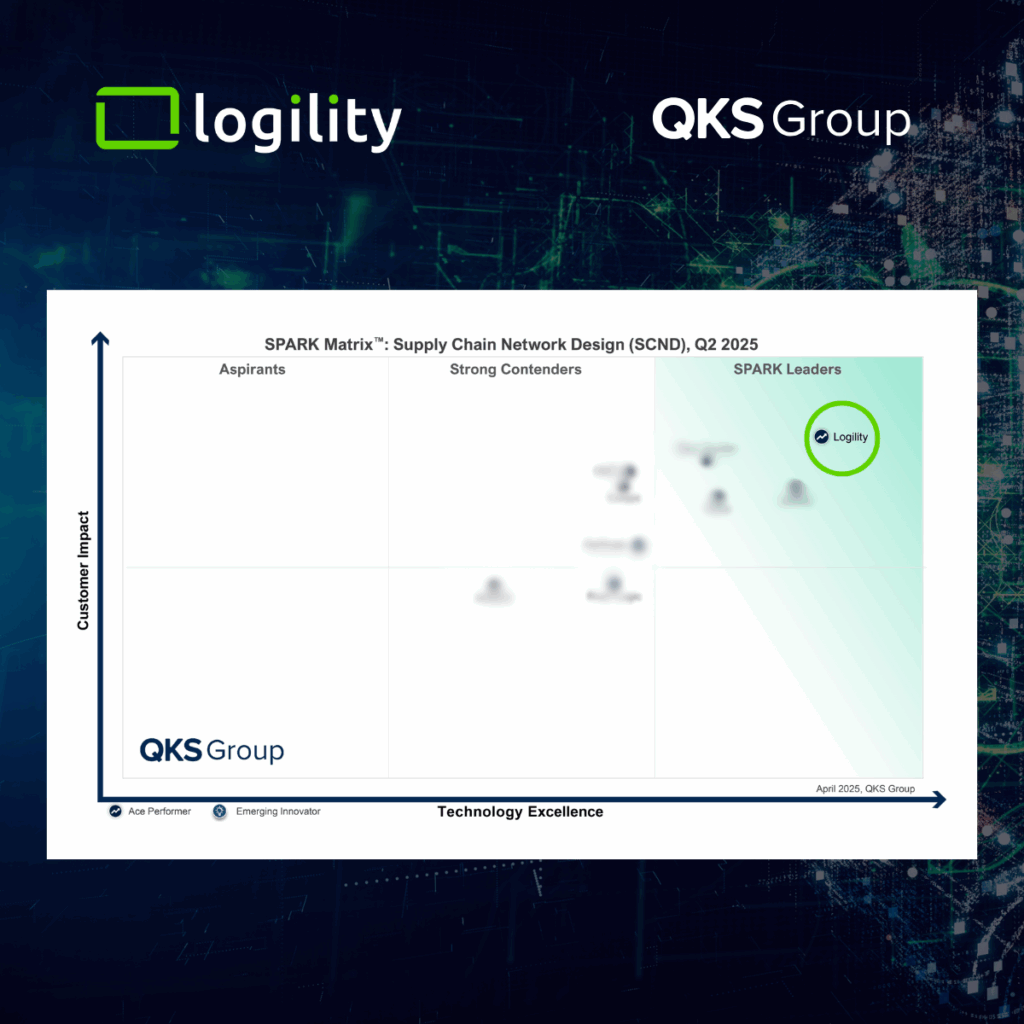
Unlock strategic insights with the QKS Group SPARK Matrix™ report, a comprehensive evaluation of leading technology vendors based on technology excellence and customer impact. This in-depth analysis covers global market dynamics, major trends, vendor landscapes, and competitive positioning, providing you with the knowledge to differentiate competitively and understand market positions.

Why Download the Report?

  • Recognized Leadership: Logility is named a leader in the SPARK Matrix™: Supply Chain Network Design 2025, thanks to our advanced AI-powered network optimization capabilities.
  • Innovative Solutions: Empower your organization with real-time scenario modeling, seamless logistics data integration, and automated planning adjustments to ensure supply chain resilience in dynamic market conditions.
  • Strategic Insights: Gain access to AI-driven insights, sustainability-focused optimization, and enhanced decision intelligence that reinforce Logility’s position as a frontrunner in the Supply Chain Network Design space.

According to Pruthvi Raj, Senior Analyst at QKS Group “Logility is redefining Supply Chain Network Design by seamlessly integrating continuous network optimization with AI-powered decision-making. Its platform enables real-time, incremental network adjustments, ensuring organizations maintain agility in response to disruptions. With a robust data management infrastructure, including Neo4J Graph Database and in-memory computing, Logility enhances scenario modeling and accelerates decision-making. Its advanced greenfield analysis and embedded analytics equip businesses with the strategic foresight needed to optimize costs, service levels, and sustainability in an increasingly volatile supply chain environment.”

What you’ll learn:

  • Comprehensive Analysis: Understand the Supply Chain Network Design market, driven by increasing complexity, frequent disruptions, and the need for data-driven decision-making.
  • Expert Opinions: Hear from industry analysts like Pruthvi Raj and Kumar Anand on how Logility is redefining supply chain network design with continuous optimization and AI-powered decision-making.
  • Future-Proof Your Supply Chain: Learn how Logility’s platform enables real-time, incremental network adjustments, ensuring agility and resilience in an unpredictable global landscape.

Download the QKS Group SPARK Matrix™ report today and stay ahead in the ever-evolving world of supply chain network design.

In the last 3 months, I have been struck by the volume of industry articles that predict major network shifts in 2025. These include the uncertainty of tariffs and counter-tariffs as well as underlying trends towards re-shoring and/or migration from China. This is in addition to the fact that the global supply chain has entered a period of relentless volatility including supplier shortages, regulatory pressures, and unpredictable disruptions.

Supply chain leaders are tasked with planning ahead, but it seems that “ahead” is coming more quickly in 2025. Primary things to plan for are:

  • Supplier mix and geographical diversity
  • Re-shoring/near-shoring where possible
  • Shifting supply away from China
  • Reducing overall route complexity and risk

In this new landscape, a strategic roadmap typically viewed yearly or less frequently needs to become a living, dynamic model. Even if the supply chain is not changing this month, the organization needs to know when suppliers, ship-from/ship-to, and carrier needs are changing. Traditional network design methods – based on complicated and brittle tools – are no longer fast enough. By the time companies finalize a response to one change, data is outdated, and circumstances have changed.

The reality of 2025 demands smarter, faster, and more adaptable supply chain strategies. For supply chain leaders, this means adopting a continuously optimized supply chain network that senses change, simulates alternatives, and adapts in real time.

Inbound Logistics Podcast: Network Optimization: Predicting Uncertainty to Produce Success

Traditional Methods Are Falling Behind

For decades, companies have approached supply chain strategy through long-term, manual assessments, with a scheduled analysis of the network’s design every one to three years. This approach made sense in an era when supply chains were more predictable.

But today, the world is moving faster toward the unknown.

Take, for example, the threat of rising tariffs and counter-tariffs. Trade regulations are constantly evolving, forcing companies to make sourcing and pricing decisions in real time. While economists agree tariffs increase costs, the broader impact extends beyond price hikes. Tariffs affect supplier viability, transportation strategies, and even customer demand, forcing businesses to continuously rethink their supply chain flows.

The organization that can sense changes, synchronize models, and explore impacts and alternatives in the same day will have a distinct advantage over the competitor who would take a month or two to model a new environment.

Meanwhile, the same challenges and expectations from the last few years persist. Labor shortages, political instability, and natural disasters continue to disrupt supply chains worldwide – leading to stockouts, delays, and lost revenue. Global carbon emissions and sustainability reporting mandates are also reshaping supply chain strategies as new regulations impact transportation routes, supplier selection, and cost structures.

As a short-term solution to these challenges, many businesses are reconfiguring their supplier networks to mitigate risk, shifting from offshoring to nearshoring and multi-sourcing. However, these strategies come with cost trade-offs, new logistics challenges, and shifting compliance requirements. Without a dynamic, continuously optimized model, companies risk making changes that introduce new inefficiencies instead of solving their problems.

Here’s the hard truth: traditional supply chain planning models aren’t built to sense and update the data that underly these multi-dimensional trade-offs.

Long analytical cycle times and rough approximations in data are creating considerable supply chain weaknesses, including:

Slow impact detection

Traditional network assessments can take weeks or months to complete. Companies don’t have time to wait for manual recalculations when faced with tariff hikes, supplier shutdowns, or sudden transportation disruptions. Delays lead to unnecessary cost increases and service failures.

Delayed decision-making cycle

The lag time in the analytical cycle also includes the time it takes to make decisions. This can often take weeks or months if the analytical teams cannot satisfy executive inquiries into recommendations and alternatives. Without the ability to create scenarios inside of a business meeting decisions are delayed. Without the ability to communicate in clear, quantitative ways, misinterpretations create further delay.

Inaccuracies and inefficiencies

Without real-time network intelligence, companies often overpay on tariffs, misallocate inventory, and fail to optimize transportation and supplier selection. Businesses that aren’t continuously optimizing their networks usually operate with outdated costs and assumptions, leading to higher operational expenses.

Continuous Network Optimization Powers Supply Chain Resilience

To keep up with today’s rapidly changing global landscape, supply chain leaders need to adopt a continuous network optimization approach. This strategy ensures that companies can anticipate disruptions, model alternatives, and adjust supply chain flows in real time—rather than scrambling to react when problems arise.

Unlike traditional methods that rely on outdated models and assumptions, continuous network optimization leverages AI-powered analytics, automation, and real-time data to create a supply chain that is:

  • Proactive, not reactive. Businesses can predict risks – from tariff changes to supplier failures – before they cause disruptions.
  • Agile and adaptive. Sourcing, transportation, and inventory flows can be adjusted based on real-time market conditions.
  • Optimized for cost, service, and sustainability. Supply chains can balance cost-efficiency and service-level requirements without compromising regulatory compliance.

The difference between a reactive supply chain and a continuously optimized one comes down to the speed at which changes in environmental data like demand, costs, or tariffs are sensed, processed, and presented to decision-makers. If this can be done autonomously (runs while you are sleeping)actions can be taken without latency.

Navigating 2025: Building a Resilient Network Amid Tariffs and Disruptions

This insightful webinar with Logility’s SVP and Industry Principle, Steve Johanson, discusses how to create and maintain a continuously optimized supply chain network.

Watch now!

How to Build Network Resilience with Continuous Optimization

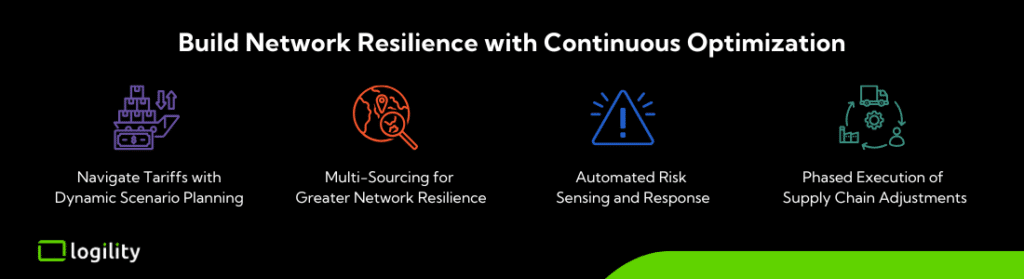
At Logility, we help companies build a continuously optimized supply chain network using AI, automation, and real-time scenario planning. Here’s how:

1. Navigating Tariffs with Dynamic Scenario Planning

Consider a U.S.-based automotive manufacturer sourcing aluminum from Asia. With new tariffs suddenly imposed on raw materials, the cost of production skyrockets. This isn’t just a pricing issue – these tariffs also threaten supplier viability, forcing the company to reassess its supplier contracts and sourcing strategy overnight.

Rather than making rushed supplier changes without analyzing broader implications or waiting until the next planning cycle to absorb increased costs, Logility’s continuous network optimization capabilities can help the manufacturer take immediate action, such as:

  • Simulate the impact of tariff changes on sourcing, transportation, and pricing before they happen
  • Identify cost-effective alternatives in seconds and adjust supplier agreements dynamically—and explore viable alternatives and adjustment.
  • Publish network changes to planning tools and phase change in with quantitative rigor

2. Multi-Sourcing for Greater Network Resilience

Suppose a consumer electronics manufacturer depends on a single-source supplier for semiconductor chips. When an unexpected geopolitical conflict halted exports, the entire supply chain came to a standstill, leading to costly delays and order backlogs.

Most companies would need to scramble to find an alternative supplier, delaying shipments by months and increasing procurement costs. However, the continuous network optimization approach enables a more optimized response, enabling the business to:

  • Diversify its supplier base in advance to ensure backup sources are available.
  • Monitor risk indicators – such as supplier financial health and geopolitical instability continuously
  • Adjust sourcing strategies automatically when disruptions occur to avoid downtime

3. Automated Risk Sensing and Response

Assume a global apparel retailer decided to shift some production from Southeast Asia to Mexico and Central America to shorten its lead times. However, without proper modeling, the move unexpectedly increased logistics costs and bottlenecked supplies as near-shore vendors struggled to meet demand.

The retailer has a choice to make – and the right one can be chosen by applying continuous network optimization tools to:

  • Compare cost and service impacts of nearshoring
  • Identify supply chain gaps and evaluate supplier readiness
  • Optimize transportation and logistics to ensure a cost-effective transition
  • Model for anticipated disruptions while having contingency plans for emergent disruptions

4. Phased Execution of Supply Chain Adjustments

Imagine a European pharmaceutical company caught off-guard by a new requirement to accelerate end to end product delivery times. Every decision in a supply chain has a ripple effect – switching suppliers or trade routes can disrupt inventory, forecasting, and fulfillment. However, the company lacked visibility into transportation emissions and supplier sustainability scores, increasing the risk of non-compliance penalties and damaging brand reputation.

By supporting continuous network optimization, Logility solutions can help the company:

  • Align distribution, inventory, and supply planning to prevent costly disruptions
  • Ensure every network adjustment is coordinated across all business units
  • Optimize supply chain flows in real time, without manual intervention
  • Adjust supplier selection based on sustainability criteria automatically
  • Ensure continuous compliance with evolving regulations, reducing penalties and risks

The Business Impact: Faster, Smarter, and More Resilient Supply Chains

Static supply chain planning is no longer viable. As disruptions, tariffs, and regulations accelerate, businesses must embrace continuous network optimization to stay competitive.

And with Logility solutions, you can too – leading to critical improvements such as:

  • 5-20% cost reduction through smarter overall network optimization
  • Increased resilience to pivot instantly in response to disruptions
  • Enhanced sustainability compliance with better emissions tracking
  • Remove latency in decision-making with AI-driven insights, reducing inefficiencies

Now is the time to optimize, adapt, and lead.

Ready to reimagine your supply chain?

Let's Chat

Atlanta, GA – January 23, 2025 – Logility, a leader in AI-first supply chain management software, is charting new territory for 2025 with AI-driven solutions designed to reshape supply chain operations. Building on the momentum of a landmark 2024, the company is introducing tools like Intelligent Order Response and Continuous Network Optimization to empower organizations with unmatched agility, precision, and scalability.

“At Logility, we are proud to partner with some of the world’s largest and most innovative organizations,” said Allan Dow, President and CEO of Logility. “We are committed to transforming the way supply chains operate. By leveraging AI and innovation, we empower our clients to navigate complexity, improve decision-making, and drive meaningful business outcomes in an ever-changing global landscape.”

2024: A Year of Impact and Innovation

Logility is redefining supply chain operations by addressing long-standing industry challenges with bold, forward-thinking strategies that have received industry recognition from analysts, industry leaders, and clients alike.

Industry Recognition:

  • Positioned as a Leader in the 2024 Gartner® Magic Quadrant™ for Supply Chain Planning Solutions, reflecting Logility’s comprehensive vision and execution capabilities. According to the report: “Logility has an above-average vision for AI as well as speed and scalability compared to other vendors in this Magic Quadrant, supporting graph technologies, GenAI and other AI/ML techniques.”
  • Additionally, a 94% willingness-to-recommend rating in the 2024 Gartner Peer Insights™ report highlights the company’s strong customer satisfaction.
  • Logility was cited as a Leader in several 2024 IDC MarketScape Reports for Worldwide Supply Chain Planning including the Discrete, Distribution, and Spare Parts industries.

New Innovations:

  • The introduction of Logility Expert Advisor (LEA) generative AI software, added AI-powered insights to support faster and smarter decision-making.
  • The new Decision Command Center offers a holistic approach to supply chain processes, leveraging data and intelligence to enhance decision-making and drive value across the entire supply chain ecosystem.
  • Dynamic Inventory modeling was developed to solve for the optimal network configuration while accounting for inventory related costs and storage capacity constraints.

2024 Virtual Summit

Logility hosted a virtual summit in 2024, an event that brought together more than 700 attendees to discuss the industry’s most pressing challenges and exciting opportunities.  Key sessions highlighted use cases for GenAI, success stories in demand planning, inventory optimization, and supply chain resilience, Logility’s product vision, and more, providing actionable insights for attendees across various industries.

Global Industry Leaders Harness Logility Solutions

Reynolds Consumer Products, showcased significant inventory cost reductions and improved forecast accuracy through Logility’s solutions at the Gartner Supply Chain Symposium. Similar success was echoed by Great Lakes Cheese and DENSO, highlighting Logility’s ability to drive efficiency and resilience at scale during the 2024 Gartner Supply Chain Planning Summits.

Davis Shumaker, Senior Manager of Supply Chain Planning for Great Lakes Cheese, an award-winning premier cheese producer and packager, shared how they revolutionized their supply chain by replacing spreadsheets with a faster, more integrated planning process built on end-to-end supply chain solutions. Great Lakes Cheese is able to leverage detailed weekly forecasting, flexible inventory segmentation, automated supply planning, and streamlined S&OP to swiftly respond to market changes.

Similarly, DENSO, the second-largest auto parts manufacturer globally, uses Logility’s AI-driven software to enhance production planning and supply chain synchronization. “The ability to simulate scenarios and optimize supply chain decisions with Logility’s technology has significantly improved our operational agility,” said Marco Turk, Demand, Inventory & Supply Planning Manager, DENSO. “We’re better positioned to navigate challenges and capitalize on opportunities in real time.”

Innovations in 2025

Logility is set to expand its suite of AI-first software in 2025 with innovations that address long-standing supply chain challenges:

  • Intelligent Order Response: A tool is designed to automate and optimize order fulfillment, bridging demand-supply imbalances with precision.
  • Continuous Network Optimization: AI-powered recommendations for real-time supply chain network adjustments, improving operational agility.

“Our 2025 innovations are designed to continue solving long-standing challenges with cutting-edge AI capabilities, empowering clients to build supply chains of the future,” said Dow.

Logility Vision25 Executive Forum

Logility is excited to announce the Logility Vision25 Executive Forum on March 6, 2025. This exclusive event is designed for senior supply chain executives to connect, learn, and innovate. This event features international keynote speakers, blueprint boardrooms, and virtual networking around Growth in 2025, Digital Transformation, Resilience in Supply Chain Operations, and Sustainability and Ethical Sourcing.

For more information about Logility’s software applications and upcoming innovations, visit www.logility.com.

About Logility

Logility is a market-leading provider of AI-first supply chain management solutions engineered to help organizations build sustainable digital supply chains that improve people’s lives and the world we live in. The company’s approach is designed to reimagine supply chain planning by shifting away from traditional “what happened” processes to an AI-driven strategy that combines the power of humans and machines to predict and be ready for what’s coming. Logility’s fully integrated, end-to-end platform helps clients know faster, turn uncertainty into opportunity, and transform supply chain from a cost center to an engine for growth. With over 500 clients in 80 countries, the company is headquartered in Atlanta, GA. Learn more at www.logility.com.

Forward Looking Statements

This press release contains forward-looking statements that are subject to substantial risks and uncertainties. There are a number of factors that could cause actual results or performance to differ materially from what is anticipated by statements made herein. These factors include, but are not limited to, continuing U.S. and global economic uncertainty and the timing and degree of business recovery; the irregular pattern of the Company’s revenues; dependence on particular market segments or customers; competitive pressures; market acceptance of the Company’s products and services; technological complexity; undetected software errors; potential product liability or warranty claims; risks associated with new product development; the challenges and risks associated with integration of acquired product lines, companies and services; uncertainty about the viability and effectiveness of strategic alliances; the Company’s ability to satisfy in a timely manner all Securities and Exchange Commission (SEC) required filings and the requirements of Section 404 of the Sarbanes-Oxley Act of 2002 and the rules and regulations adopted under that Section; as well as a number of other risk factors that could affect the Company’s future performance. For further information about risks the Company could experience as well as other information, please refer to the Company’s current Form 10-K and other reports and documents subsequently filed with the SEC. For more information, contact: Kevin Liu, Logility Supply Chain Solutions, Inc., (626) 657-0013 or email kliu@amsoftware.com.