Key Takeaways
- The gap between AI’s potential and its impact in manufacturing is an architecture problem, not an algorithm problem. More data and better models get an organization to a good starting point, but they do not make the decision process itself any faster or better.
- AI creates value only when its insights enable faster and smarter action. A recommendation that lands in a report or dashboard still requires someone to read it, decide, and manually translate it into action, by which point the window may have already closed.
- AI tools can only do so much when data is siloed, delayed, or stripped of context. AI operating on fragmented data with no direct connection to the workflows affected will inherit that same latency.
- Effective AI needs live contextual data and clear execution pathways. The execution layer is not a nice-to-have for AI in manufacturing; it’s a prerequisite.
- Logility Digital Factory supplies the operational foundation, while the Logility Orchestration Center turns data into decisions and decisions into action. Agents monitor operations and trigger structured responses, Generative AI surfaces insights in plain language, and workflow orchestration routes decisions automatically, turning even years of shift-log data into a queryable operational memory.
From Data to Decisions: How AI Actually Works in a Connected Factory
Manufacturing organizations aren’t short on data. They’re not short on artificial intelligence (AI) tools, either. What most are short on is the connection between the two—and that missing connection is why so many AI initiatives in manufacturing produce dashboards rather than decisions.
The gap between AI’s potential and its impact isn’t an algorithm problem. It’s an architecture problem. And until that architecture is in place, more data and better models will not close it.
The Misconception: A Lot of Good Data Equals Better Decisions
The prevailing assumption behind most AI investments in manufacturing is straightforward: if you have enough data, and that data is high quality, better outcomes follow. This is a reasonable assumption given how AI is portrayed in the media, but It’s not entirely accurate.
More data and higher data quality are necessary, and they get your organization to the best possible starting point for a decision. But they don’t make the decision process itself any faster. So data and models are necessary but not entirely sufficient.
The missing ingredient is not on the input side of the equation, but the output side. Specifically: what happens after the model produces a recommendation?
In most manufacturing environments, the answer is “not much.” The recommendation lands in a report, or a dashboard, or an email summary. A person reads it, assesses it, decides whether to act on it, and then—if they do decide to act—manually translates it into a request that eventually reaches the system or team that needs to do something. By the time the action happens, the window the AI identified may already have closed.
This is exactly where AI can help close the gap; not by producing yet another recommendation, but by shortening the decision process itself. That’s accomplished by pairing analysis with a direct path to execution, often through a structured approval or commitment step so the accountable person can authorize the action in seconds rather than reconstructing the context from scratch and assessing from there.
AI does not create value when it generates insights. It creates value when those insights enable faster and smarter action.
The Real Problem: Decision Latency
The delay between an AI system identifying a situation and an organization executing an effective response is known as decision latency. It’s the result of accumulated friction of fragmented data, disconnected systems, and manual coordination steps that sit between insight and action.
It’s important to note that decision latency is not caused by slow people or poor processes. It’s caused by architecture. When AI operates on data that is siloed, delayed, or stripped of operational context, latency is built into the system by design. And when its outputs have no direct connection to the systems and workflows that need to take action based on that data, that latency increases.
The consequences are predictable: AI recommendations that can’t be acted on quickly enough to matter, operational decisions made on data that describes yesterday rather than now, and a persistent gap between what the technology is capable of and what it actually delivers.
What AI Actually Needs to Work
The requirements for AI that delivers operational impact in manufacturing are specific. It’s not about model sophistication, but the operational foundation the model sits on.
AI needs live data, not batch exports or daily syncs. In a manufacturing environment where conditions change shift by shift, operating on yesterday’s data means every recommendation is based on old data.
AI also needs context with its data, not just raw signals. That’s because the conditions under which data was generated matter as much as the data itself. A quality flag raised automatically mid-cycle carries different weight than one logged manually at the end of a shift. AI without that context cannot reason accurately about what the signal means or what should happen next.
And critically, AI needs execution pathways. A recommendation that cannot trigger a structured response is, at best, an additional report. For AI to reduce decision latency, it needs to be embedded in the workflows that connect insight to action, not sitting beside them.
The execution layer is not a nice-to-have for AI in manufacturing. It’s a prerequisite.
The Connected Factory as the AI Execution Layer
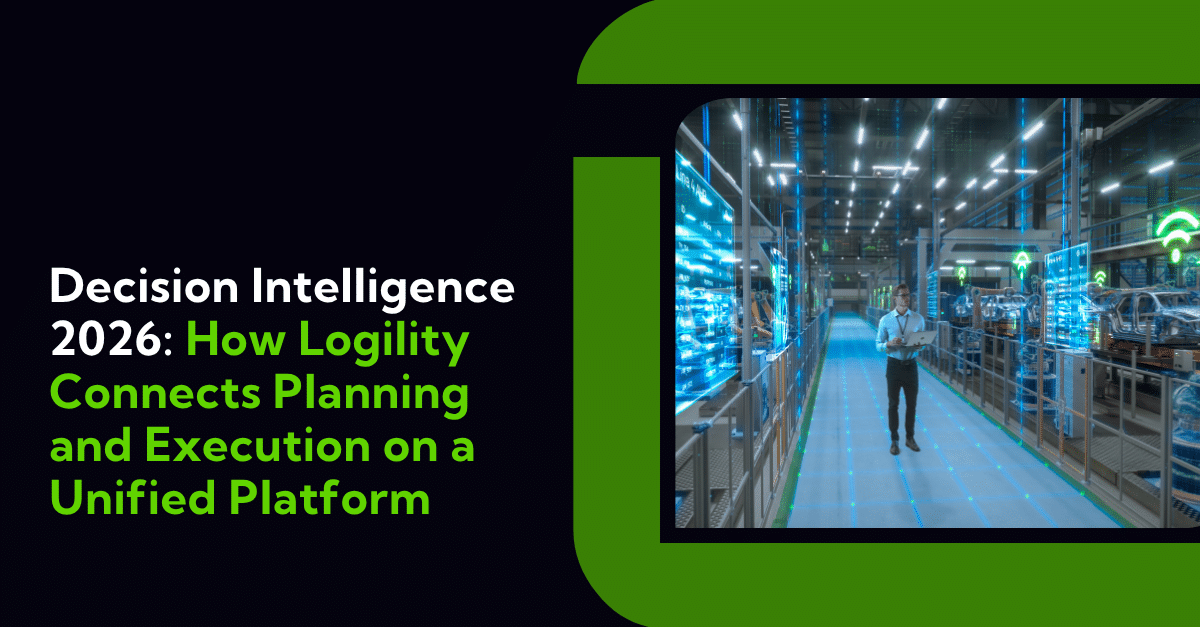
This is where Logility Digital Factory changes the equation. Far more than an AI tool, it’s the operational architecture that gives AI tools something to act on.
By connecting production, quality, maintenance, and workforce data into a unified real-time operational model and linking that model directly to supply chain planning, Logility Digital Factory creates the data foundation that AI requires: live, contextual, harmonized, and operationally meaningful.
On top of that foundation, Logility Orchestration Center provides the AI capabilities that translate data into decisions and decisions into action: agents that monitor operations and trigger structured responses autonomously, generative AI that surfaces insights in plain language so the right person can act immediately, and workflow orchestration that routes decisions to the right place without manual intervention.
This example makes it concrete. Most manufacturing organizations have years of operational knowledge locked in shift logs containing thousands of entries in multiple languages, all written at the end of long shifts. So that knowledge exists, but without a connected execution layer, it’s effectively inaccessible.
With Logility Digital Factory connecting that data to AI, the same shift logs become a queryable operational memory: what happened in the last two days, which events need action, what patterns suggest an emerging problem. This allows you to use that knowledge to inform smarter action.
Execution Is What Turns AI Into Impact
The organizations seeing real AI impact in manufacturing are not working with fundamentally different algorithms. They’re working with a fundamentally different operational foundation—one where data flows without friction, decisions have clear pathways to action, and AI is embedded in operations rather than observing from the outside.
The question to ask of any AI initiative is not “how good is the model?” but “when this model produces a recommendation, what happens next and how fast can action be taken?” If the answer involves manual steps, system gaps, or coordination delays, the execution layer is the limiting factor, not the model’s accuracy.
Build the execution layer first. The AI will follow.
From data to decisions to action—the path has to be connected end to end. That is what Logility Digital Factory is built to do. Contact us today to learn more about what our solutions can do for your operations, or schedule your personalized demo.