Short on Time? Here’s What You Need to Know
According to a market study by Mordor Intelligence, the global cloud supply chain management market will reach $30.56 billion by 2031, growing at a compound annual rate of nearly 17%. Here’s how the right platform can satisfy this growing demand inside your organization:Key Takeaways
- Prebuilt integrations, data quality checks and real-time synchronization help your teams plan from current, consistent information.
- Rolling scenario planning and elastic capacity help you respond to disruption and changing workloads without infrastructure holding you back.
- Security, governance and compliance capabilities help you protect your planning data and meet business and regulatory requirements.
- Cloud-based access connects your teams, sites, suppliers and customers to the information they need to make better decisions.
- A connected and flexible cloud platform is an important prerequisite for adopting artificial intelligence (AI) and other emerging technologies.
Introduction
Learn how cloud-based supply chain planning software connects data, scales resources and supports smarter organizational decisions.
Many companies are moving away from on-premise planning systems and toward cloud-based platforms, and it’s easy to see why. The capital cost of maintaining server infrastructure adds up fast, and that’s before you factor in the limited scalability you get without new infrastructure investment.
On top of that, on-site systems frequently struggle to deliver live data, pushing management teams into reactive decision-making and firefighting rather than proactive planning. Legacy architecture also makes it difficult to integrate new technology as it emerges, leaving you behind unless you can afford to update your infrastructure. Together, these issues create a bottleneck that slows planning when speed matters most.
Cloud-based supply chain planning software can improve business processes in several key ways. For example, cloud software can:
- Streamline how you connect planning data, expand resources and give your people access to plans across locations and organizations.
- Allow your organization to focus on running a business rather than on building and maintaining compliant and secure software architecture.
- Provide a foundation for adopting AI and other emerging technologies without rebuilding your underlying planning environment.
In this article, we discuss how cloud-based planning works, what to assess before migrating and which capabilities to evaluate when selecting a platform.
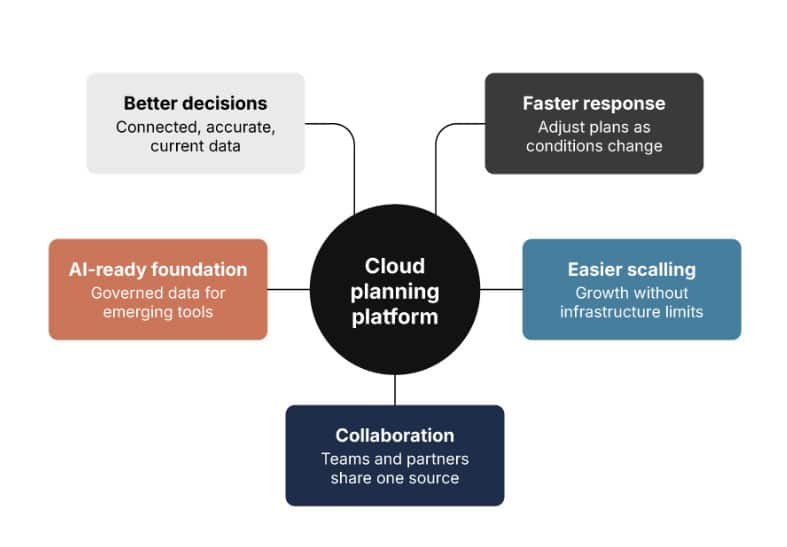
What cloud-based supply chain planning software can deliver
How Should You Prepare for Cloud Migration?
Before evaluating software options, the more foundational step is taking the time to audit your current planning process as it actually operates today, not as it’s documented to operate. We suggest the following five steps:
- Map your data sources: Identify all systems, spreadsheets, artifacts and groups that supply planning data or influence planning decisions.
- Identify manual workarounds: Find where data is exported, cleaned or manually reconciled to pinpoint the biggest opportunities for automation.
- Find recurring data errors: Ask the people responsible for reconciliation which fields cause the most frequent problems and how they’re currently resolved.
- Document update frequency: Record how often each source is refreshed to determine where more frequent updates could support continuous planning.
- Identify missing information: Look for data, inputs or planning considerations that are missing from the current process but should be part of a holistic planning approach.
- Assign ownership: Identify who is accountable for each data source and planning activity so you can address gaps or ambiguous responsibilities.
Performing this type of audit before implementing a new system avoids automating an already broken process “as is” and gives you insight into how to clean things up before rolling out a new system.
How Does Cloud-Based Planning Connect Your Data?
Once your organization is ready to migrate, one of the first questions is how you’ll bring your data together. Your plans are only as reliable as the information behind them, but how can you reconcile information scattered across enterprise resource planning (ERP), warehouse management systems (WMS) and transportation management systems (TMS) that weren’t designed to communicate with each other in real time, if at all?
Instead of relying on spreadsheets or other manual workarounds, your supply chain planning software should do the heavy lifting. It should quickly and reliably connect, standardize, validate and update data across the supply chain through two core capabilities: templated connectors and built-in data quality checks.
Prebuilt, Templated Connectors to ERP, WMS and TMS Systems
Templated connectors are prebuilt, ready-to-use integration links between two systems (like an ERP and WMS) that come with the data mapping and configuration already built in. When a system uses templated connectors, it reduces the need for custom, point-to-point integration work that stretches out implementation timelines, adds a risk of data not migrating properly and lacks standardization.
Templated connectors can also ease the ongoing burden of maintaining integrations. For example, they can help your organization:
- Reduce the total cost of ownership: Vendor-maintained connectors shift the ongoing maintenance burden from your internal information technology (IT) team to the vendor, which reduces lifecycle costs beyond just the initial implementation
- Maintain data consistency at the source: Standardized mappings help maintain consistent definitions for fields such as units of measure (UOM), stock-keeping unit (SKU) hierarchies and lead times across systems
- Lower technical barriers for adoption: Your team can configure connector mappings with less IT team involvement, making it easier to onboard new sites, business units or acquired entities
Built-In Data Quality Checks During Integration
Connecting systems doesn’t automatically make the data reliable. If required fields are missing, SKUs are duplicated, or units of measure are inconsistent, those problems can undermine the plans built from that data. Garbage in, garbage out, as the expression goes.
Built-in data quality checks address these issues at the source rather than letting problems surface downstream where they’re more expensive to trace and fix. This can provide several benefits:
- Protecting data integrity by flagging missing fields and catching errors in UOM, duplicate SKUs and duplicate suppliers
- Shortening implementation by reducing manual validation and the human error that comes with it
- Building organizational trust in the data and plans within the system
- Turning data quality into an ongoing discipline rather than a one-time cleanup effort
However, before built-in checks can add value, your organization first needs to define what good data looks like and who is responsible for maintaining it. For example, supply chain, IT and finance may each have different priorities for master data. Procurement may need specific supplier fields to be complete, while demand planning may depend more heavily on product hierarchies and historical demand data. Establish these rules as a cross-functional effort to ensure that the system is checking for issues that actually affect business decisions.
You’ll also need to determine who resolves an issue once it’s flagged. Assign an owner to each major data domain, and establish a timeframe for resolving exceptions. As an example, the supply chain team might own supplier data and have one week to address flagged issues.
When these practices are implemented, they prevent data-quality exceptions from becoming an endless queue of IT tickets and allow data quality checks to fulfill their ultimate purpose: keeping planning data accurate and actionable over time.
How Can a Cloud Platform Help You Plan and Adapt?
Connected, accurate data only creates value if your team can act on it quickly. A cloud-based planning platform can help you continuously adjust plans as conditions change while scaling to support growth. The table below highlights four cloud capabilities that make this possible.
| Without a cloud platform | With a cloud platform |
|---|---|
| Batch, infrequent updates | Continuous recalibration |
| Static plans, limited alternatives | Rolling scenario planning |
| Infrastructure limits growth | Elastic capacity scales with demand |
| Stale snapshots | Real-time data synchronization |
Let’s take a look at each of these capabilities in greater depth.
Continuous Recalibration
Continuous recalibration can help limit the bullwhip effect by making smaller adjustments based on current conditions rather than reacting to outdated, batched signals. For example, if a retailer sees a 10% demand increase during a two-week promotion, a distributor with infrequent planning cycles may mistake that temporary spike for sustained growth and increase orders accordingly.
By contrast, a cloud-based system with continuous recalibration could capture the demand signal, account for its timing and context, and dynamically calibrate its downstream impact across the supply chain. Planners can then adjust orders more proportionally to reduce the risk of excess inventory.
Rolling Scenario Planning
Rolling scenario planning helps your team determine how to respond when the right course of action isn’t immediately clear. As conditions change, you can model alternatives such as:
- Treating the increase as promotional: Adding a modest buffer and planning for demand to return to baseline after the promotion
- Planning for sustained growth: Increasing supply more aggressively in case the promotion leads to lasting demand
- Holding and monitoring: Avoiding major changes and reassessing as additional data becomes available
AI can make this process more dynamic. It can help planners identify relevant scenarios, surface variables that could affect outcomes and compare potential plans against business objectives. Choose a tool that can use current supply chain data to identify meaningful scenarios, explain the assumptions behind them and keep recommendations aligned with your organization’s planning objectives. Your planners can then evaluate the trade-offs between scenarios and decide how to proceed.
Scalability and Elastic Capacity
Business growth doesn’t wait for infrastructure to catch up. If your system can’t support potential growth without infrastructure investment and new implementations, you’re limiting your ability to grow.
Cloud-based solutions have the ability to flex with business growth, seasonal product launches and acquisitions without requiring new software infrastructure. That flexibility can help you take on larger planning volumes or more complex scenarios without making infrastructure capacity a constraint on business decisions. It can also reduce the need for major infrastructure projects when planning requirements change or when integrating AI capabilities.
Real-Time Data Synchronization
Static snapshots can only tell you so much. If a production schedule changes five minutes after your last refresh, your plan may already be out of date.
Real-time synchronization keeps your planning data current as conditions change. Look for tools that automatically synchronize data across systems, such as ERP, WMS, TMS and manufacturing platforms. In addition, the tool should easily connect external data, such as point-of-sale, competitor or customer information, to your planning process.
What Makes a Cloud Platform Enterprise-Ready?
As you extend planning across teams, locations and external partners, broader access also creates new requirements around security, collaboration, and the ability to keep up with emerging technologies. As you evaluate platforms, pay particular attention to security and governance, collaboration and support for emerging technologies.
Security, Governance and Compliance
Security is an important consideration when comparing planning platforms, whether cloud or on-premises. The cost and complexity of different approaches depend on factors such as your provider, architecture, existing IT capabilities and regulatory requirements.
With a cloud platform, the provider maintains the underlying security infrastructure while your organization remains responsible for evaluating whether its controls meet your requirements. Look for relevant security certifications, granular role-based access controls and built-in audit trails.
Specifically, role-based access controls should allow permissions to be defined at different levels, such as by module, data field, transaction type or business unit. Audit trails should provide visibility into who changed what and when, giving your team a documented record when you need to investigate changes or support an audit.
Shared Access and Collaboration
A connected cloud environment should also provide the foundation for adopting AI and other emerging capabilities. Rather than building new infrastructure each time you want to introduce a new technology, a modern cloud platform can make it easier to integrate new capabilities with the systems and data you already have in place. That flexibility can help your organization adopt new tools as they become available while keeping planning information connected and governed.
What Are the Benefits of Cloud-Based Supply Chain Planning?
We’ve now discussed several capabilities and benefits of effective cloud-based supply chain planning software. Together, they create a continuous planning cycle that helps your organization stay responsive as conditions change. To summarize, an effective solution can help you:
- Synchronize data: Bring together current information from across your supply chain so that your teams can plan from a connected, accurate source of data
- Recalibrate plans: Adjust plans as demand, supply and other conditions change rather than waiting for the next planning cycle
- Model scenarios: Compare alternatives and evaluate trade-offs to determine how different decisions could affect your business objectives
- Scale capacity: Flex with growth, seasonal demand, new locations and changing workloads without making infrastructure a constraint
- Collaborate more effectively: Give internal teams and external partners access to the planning information they need to coordinate decisions
- Prepare for AI and emerging technologies: Build a connected cloud foundation that makes it easier to integrate new capabilities as they become available
In short, the right cloud-based planning platform can help your team move from static, periodic planning to a continuous cycle of synchronizing data, recalibrating plans, modeling scenarios and scaling capacity as your business changes.
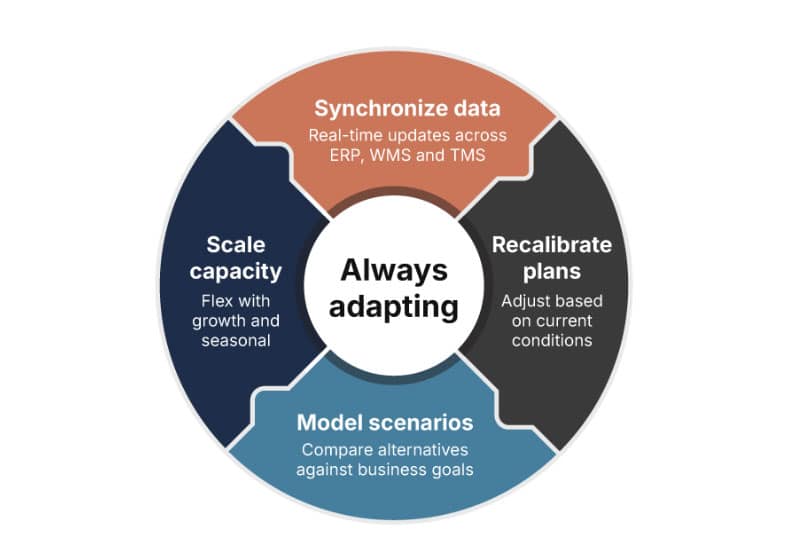
The continuous planning cycle
Working with a Trusted Partner
Ultimately, realizing the advantages of cloud-based planning hinges on careful preparation, choosing the right platform and continuing to evolve your implementation strategy. While the process can seem daunting, leaning on the expertise of a trusted partner can help.
Aptean’s supply chain management software brings prebuilt integrations, continuous scenario planning and enterprise-ready security together in a single cloud platform, backed by a team that understands the industries you operate in. Its solutions can be configured to meet your organization’s needs from planning and sourcing to inventory optimization and fulfillment. Its capabilities also provide a foundation for incorporating AI into planning and decision-making as your needs evolve.
Ready to see what that could mean for your organization? Request a demo or contact us to start the conversation.