What You’ll Learn
Supply chains generate more data than ever, but data alone won’t help you act faster. In this blog, you’ll learn how AI agents connect signals across your business, improve decisions and turn insights into action. You’ll explore the following:
- How agents help detect disruptions earlier by continuously monitoring demand, supply, inventory, production, logistics and external market signals.
- How you can use AI agents to keep demand, supply, inventory and production plans aligned as conditions change.
- How agentic AI coordinates actions across different enterprise systems.
- Why AI governance matters and how guardrails, human oversight and explainable decision-making support responsible AI.
- Best practices for building an AI-ready supply chain, from creating a strong data foundation to choosing a purpose-built platform.
Introduction
For years, businesses have poured money into getting better data, dashboards and forecasting tools, but most organizations still find themselves reacting to disruptions rather than staying ahead of them. The core problem often isn’t a lack of information; it’s what happens after that information arrives.
In response to these challenges, artificial intelligence (AI) is becoming embedded across every layer of the supply chain, from sensing and forecasting to execution. AI agents in the supply chain help cut through the noise by continuously monitoring disruption signals, surfacing the most important insights and turning them into actions that can be executed across supply chain systems in near real time. The power is not only in making better decisions but reducing the decision latency and acting as the speed of opportunity.
In this blog, we examine each layer of the supply chain process and how agentic AI can play a role at key stages.
Overview of AI Agents in the Supply Chain
Before diving into how AI agents can provide practical value for your business, let’s define what they are, how they differ from other technologies that come up in conversations about AI and how they operate within the supply chain.
AI agents are action-takers. Whereas other types of AI generate content or predict future outcomes, AI agents are digital coworkers that execute complex workflows with a degree of autonomy. For example, an AI agent might:
- Detect that a supplier delay will create an inventory shortfall
- Evaluate alternative suppliers and available stock
- Recommend an appropriate response
- Automatically update purchase orders or replenishment plans within predefined business rules
What makes this AI agentic is the ability to move from insight to action across multiple steps and systems. An AI agent can gather information; reason about what to do next; use tools to interact with systems such as your enterprise resource planning (ERP) system, warehouse management system (WMS) or transportation management system (TMS); and adjust its actions as conditions change.
This autonomy doesn’t mean operating without oversight. To work reliably and safely at scale, AI agents must operate within a carefully defined harness, which brings together the components required to govern their actions:
- Prompts that define the agent’s persona, purpose and style
- Guardrails that define what it must never do or when to request approval
- Orchestration that coordinates multi-step workflows and handoffs
- Tools that take actions like sending emails or querying a database
- Observability that monitors the agent’s step-by-step actions
With these components in place, the harness helps determine what an agent can do autonomously, when it needs human approval and how you can monitor and audit its actions.
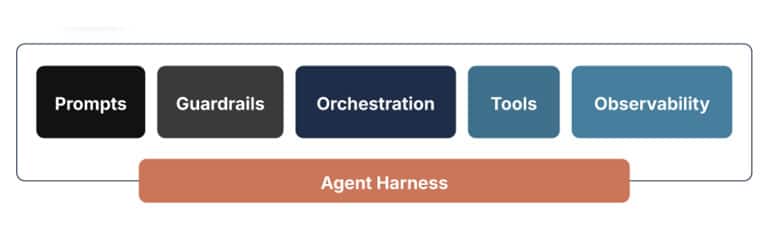
The components of an AI agent harness used for governance
How AI Agents Connect Supply Chain Signals
Before we examine specific use cases for AI agents in the supply chain, let’s look at another example that illustrates how AI agents can connect signals that would otherwise remain siloed.
Imagine that a key overseas supplier for your organization flags a shortage of raw materials that will delay production. At the same time, a large wholesale customer submits a bulk order well above its usual volume, hoping to lock in current pricing before an expected increase. Meanwhile, the yield on a production line for that product has drifted down for four shifts. Together, these events create three signals: one that impacts supply, one that impacts demand and a third that hits capacity. Collectively, they put fulfillment and work orders at risk.
In a traditional operation, these signals remain disconnected: Procurement reviews the supplier delay, sales enters the order, and the plant works on the yield issue locally. The three parties meet at next Tuesday’s planning review, by which point the decision window has closed. Because signals converge on a weekly cadence while the situation moves in hours, no party is able to respond proactively.
The gap usually isn’t a lack of data. It’s that the data is disconnected and the system is unable to support action. Most organizations already run ERP, WMS, TMS, manufacturing execution systems (MES), quality management systems (QMS), customer relationship management (CRM) and supplier relationship management (SRM) solutions with the necessary data in place. So the data already exists somewhere in the stack, but it’s not wired to a response.
By contrast, when AI agents operate effectively across connected supply chain systems, these signals can be evaluated together. The delay is matched against open orders, the new demand is checked against capacity, and the conflict becomes a real-time decision point of whether to shift production schedules, expedite alternate materials or reset customer expectations. The AI recognizes that the bulk order may represent demand pulled forward rather than newly created demand, since the customer’s annual volume is already committed. It factors that context into several response options, each showing the impact on margin, expedited freight, capacity and on time in full (OTIF) delivery rate. The planner chooses the best course of action; once approved, the agent executes it.
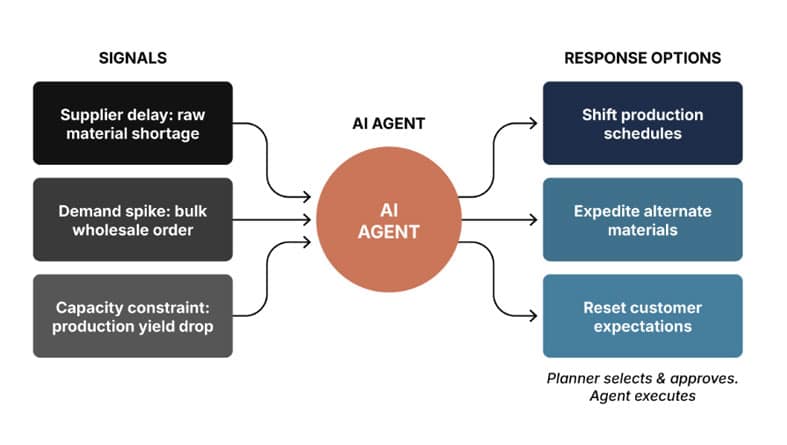
AI agents connect signals across supply, demand and production
This is one example of how AI agents can reshape supply chain operations. They don’t replace planners and analysts—they evaluate signals across systems and turn them into coordinated decisions and actions.
Examples of AI Agents in the Supply Chain
AI agents can take on distinct roles depending on where they sit in the supply chain. The sections below walk through four key areas where agentic AI is already changing how work gets done, from sensing disruptions to managing inventory in real time.
Environmental Sensing
Environmental sensing is the continuous collection and interpretation of signals from across the business and the outside world that affect an organization. Modern AI solutions bring these signals together in real time; helping you understand what’s happening now; identifying emerging risks and opportunities; and acting before risks become business-critical. The table below lists common signals for environmental sensing.
| Category | Example Data | What It Signals |
|---|---|---|
| Macroeconomic indicators | Inflation rates, interest rates and GDP trends | Demand environment and purchasing power shifts |
| Geopolitical signals | Sanctions, tariffs, trade restrictions and port closures | Supply disruption risk and trade flow constraints |
| Weather and climate data | Hurricanes, heat waves, drought and storms | Short-term disruption risk to supply, production, inventory, transportation and demand |
| Transportation and logistics conditions | Port congestion, freight rates, carrier capacity, shipment delays and ETA variance | Network bottlenecks, transit delays and fulfillment reliability |
| Commodity and input pricing | Oil, steel, grain and semiconductor prices | Cost pressure and upstream supply volatility |
| Market signals | Social media trends, search trends, reviews, competitor pricing, promotions and product launches | Emerging demand shifts, preference changes and competitive pressure |
| Regulatory changes | Labor laws, emissions rules and import/export policy | Structural cost and supply chain constraint changes |
On their own, these signals aren’t actionable. The data points are nice to know, but the volume, formats and origin are difficult for a human team to monitor, interpret and act on manually. AI changes what’s possible in a few ways:
- Continuous, automated monitoring flags meaningful shifts the moment they emerge
- Pattern recognition separates real trends from ordinary variability
- Cross-system correlation connects a signal in one system (e.g., a supplier’s late shipment) to its downstream effect in another (e.g., production schedule risk)
- Contextualization and prioritization help teams focus on the signals that matter most and understand the potential business impact
Supply chains have become much harder to predict because post-pandemic changes, geopolitical volatility, rising energy costs and more frequent climate-related events are pushing risk to new levels and demanding faster, more adaptive responses. AI agents built for environmental sensing give you a way to continuously understand what is changing around and within a supply chain, empowering your organization to anticipate risk, identify opportunities and act before disruptions become business-critical.
Becomes Continuous Planning
Once changing conditions and potential disruptions are identified, planning turns that awareness into a coordinated course of action across demand, supply, inventory and production. Traditionally, planning has been a slow, sequential and functionally disconnected process: Demand planning happens, supply planning reacts, and production plans around the resulting constraints, often on a weekly or monthly cadence.
AI agents make planning more adaptive in several concrete ways:
- Plans are continuously rebalanced as new demand, supply and capacity information becomes available
- Planning decisions stay synchronized across demand, supply, inventory and production so that every function works from the same assumptions
- Dynamic scenario modeling lets planners simulate what-ifs and weigh tradeoffs across service, cost, capacity and inventory
- AI agents identify emerging tradeoffs, recommend adjustments and help teams move from analysis to action faster
Rather than being a periodic, disconnected process, planning becomes a continuously updated, system-wide function that aligns decisions with current conditions and business objectives, enabling organizations to adapt plans as conditions change.
Production and Logistics Execution
AI agents change execution from a process involving fixed schedules and rules to a practice of continuous, real-time optimization. Instead of waiting for manual intervention, they respond to live conditions and adjust decisions as conditions change.
That means execution becomes adaptive across production and logistics. In production, it connects shop-floor signals such as machine performance, labor capacity and quality data directly to supply chain decisions so that schedules adjust to real constraints and issues get caught early. In logistics, it optimizes the movement, storage and delivery of goods from suppliers to customers based on signals such as transportation constraints, carrier performance and external conditions. This might mean shifting warehouse workloads or picking different carriers based on cost, speed and capacity tradeoffs.
Across both domains, AI-driven orchestration can push decisions directly into the operational systems that run day-to-day work—ERP, WMS, TMS, MES and beyond—so a decision doesn’t stall as a recommendation nobody acts on. The result is execution that behaves less like a rigid plan and more like a live optimization system. Instead of just carrying out instructions, the system reviews and fine-tunes operations to improve efficiency, reduce waste and make better use of assets as conditions evolve.
Dynamic Inventory Management
Inventory sits at the intersection of every other function. This is where demand volatility, supply delays and production changes all show up as either excess stock or stockouts. Getting it right has always been a balancing act, and traditional inventory management tends to rely on static safety-stock rules and periodic reviews that lag behind actual conditions.
Agentic AI uses a more dynamic approach. Safety stock and reorder points are continuously evaluated and adjusted as demand, supply, lead times and other conditions change. Inventory gets right-sized by location and position, determining not just how much to hold but also where to store it based on demand while minimizing cost and risk. The system responds faster to shifts in demand and supply while continuously improving recommendations based on forecast accuracy, actual demand patterns and changing conditions.
Done well, this is where some of the most measurable AI-driven gains show: lower carrying costs, fewer stockouts, improved service levels and inventory that’s positioned where it’s actually needed rather than where it happened to land.
Building a Strong, Connected Data Foundation for AI Agents
AI agents are only as good as the data they operate on. An agent deciding how to respond to a supplier delay, for example, may need to evaluate supplier lead times from your ERP, current inventory from your WMS, production capacity from your MES and open customer orders from your CRM. If that data is incomplete, inconsistent or difficult to reconcile across systems, the agent may lack the context it needs to make a reliable decision.
One of the greatest challenges is ensuring that all information is accurate and structured consistently enough for AI agents to interpret it correctly. To prepare data for AI agents’ use, focus on four core practices:
- Cleansing: Removing errors, duplicates, missing values and inconsistent formatting (e.g., “St.” vs. “Street”).
- Standardization: Putting data into consistent formats, units and structures so systems and models can identify and compare datasets.
- Deduplication: Identifying and merging records that refer to the same entity but were entered or captured incorrectly.
- Bias detection: Reconciling demand history to remove the effects of stockouts, promotions or one-time disruptions so that models learn true demand patterns rather than distorted signals.
None of this is one-time work. As data, business conditions and agent performance evolve, continuously monitor outcomes, validate results against real-world performance and refine the data and logic your agents rely on.
Governing AI Agents
As AI agents take on a larger role in supply chain decisions, governance becomes a critical concern. The goal is to give agents enough autonomy to be useful while maintaining clear boundaries around what they can access and do.
Start by defining which decisions an agent can make independently and which require human approval. For example, an agent might shift a production run to another line to absorb a small demand spike on its own but require sign-off before pulling forward an entire production schedule. These rules become part of the guardrails that keep agents operating within acceptable business limits.
You also need visibility into how agents perform. Track the data they use; the recommendations and actions they make; and the outcomes that follow so your teams can identify errors or declining performance early. In addition, because agents may access sensitive supplier, pricing and cost data, limit their access to only the systems and information they need.
Most importantly, formalize these controls through an AI governance framework. Aptean’s 2026 Artificial Intelligence Research found that while 96% of leaders say a formal governance framework is necessary to use AI safely, 37% haven’t built one, and 75% cite that gap as a major barrier to AI success.
Building this sort of framework takes time and iteration. Start with the following steps:
- Document each agent’s purpose, the data and systems it can access and the actions it is authorized to take
- Assign clear ownership so someone remains accountable for each agentic system’s performance
- Establish risk-based approval processes that apply greater scrutiny to higher-impact agents and decisions
- Train employees on how agents should be used, where their limitations lie and when human judgment is required
While it isn’t possible to eliminate every possible risk, an AI governance framework puts practical controls around how agents operate and creates accountability for their actions.
How Aptean Turns Insight Into Action
As we have discussed, the technology to sense, plan and act on supply chain signals in real time already exists. What separates high-performing supply chains from the rest isn’t more data or more dashboards. It’s the distance between what your organization knows and what it does about it.
Working with a trusted partner can help. Aptean provides a suite of tools to help you integrate AI agents into the systems and workflows your teams already use with the right data, prompts, guardrails and tools behind them. This includes:
- Industry-specific applications for planning, manufacturing and logistics
- The Aptean AI Operating System, an intelligence layer that connects disparate systems and grounds AI in your operational data and workflows
- Aptean AppCentral, which puts that intelligence into the hands of your teams through natural-language chat, role-specific workspaces and background agents
- Aptean Intelligence as a Service, a fully managed service that pairs with AppCentral to take you from strategy to fully deployed AI agents
Together, these capabilities provide a practical path to deploying properly configured agents without requiring your teams to build the underlying AI capabilities from scratch.
For more on how Aptean’s solutions can work for your business, contact us or request a demo. You can also learn more about Aptean Intelligence on our website.