Agentic AI powering autonomous agents will lead the next revolution in supply chain management.
As supply chains become more complex and move faster than ever, organizations can no longer keep pace with manual processes and traditional planning strategies. Many companies are now adopting AI at a record pace, using it to process, analyze, and gain valuable insights from the data.
However, while Generative AI makes analytics conversational, follow-up is still manual. Agentic AI closes the gap by continuously monitoring signals and proposing or taking contextual actions. Autonomous agents extend this capability by acting independently within defined goals, enabling systems to sense, decide, and execute without constant human intervention. For supply chains facing constant disruption, it can turn planning from a periodic action to a perpetual action where the system continually senses changes, makes decisions, and helps execute in the workflow.
Organizations that learn how to navigate the disruption with Agentic AI will be 70% ahead of their competition and can create plans at 30% of the cost while achieving 20% higher forecast accuracy.
From Generative AI to Agentic AI
The coming changes from AI will be as significant as the industrial or PC revolution. General-purpose intelligence is becoming as accessible and ubiquitous as electricity, while highly capable intelligence will soon be available at minimal cost and embedded everywhere across the economy. Agentic AI is essentially a smart software with modules for perception, memory, planning, and action. Autonomous agents are the operational layer of this intelligence, designed to execute tasks and collaborate without direct supervision. AI agents demonstrate logical reasoning and planning by analyzing their environment and breaking down complex tasks into smaller components. These agents also have long-term memory and reflection, with the ability to draw on past interactions to better understand intention and context while learning from experience. Agents can make decisions, collaborate, and act autonomously to pursue goals without constant human interaction.
In supply chain planning, Agentic AI uses “always on” monitoring across multiple data streams, such as orders, inventory, and supplier updates, to keep information current. As the system is designed and built to detect change, it can surface anomalies as they occur. Unlike Generative AI, which may just present basic information in dashboards, Agentic AI frames options, trade-offs, and likely impacts. Autonomous agents then take these insights and execute actions within workflows, reducing latency and improving responsiveness. In this sense, it automates most of the work and presents information and options for humans to take accountability and make decisions. Humans set the goals, and the Agentic AI systems work autonomously to achieve them, even adapting their strategies when necessary. This approach prioritizes contextual learning over rigid rules, allowing the agent to adapt its thresholds and prompts as it gains exposure to outcomes and exceptions.
These capabilities offer many practical applications in the supply chain, enabling plans to be adjusted as assumptions change. It can also identify risk, shorten response time in crisis, and offer more options with the ability to support real-time cross-functional collaboration and work across other software platforms and interact with other organizations.
Why Agentic AI Matters in Supply Chain
Traditional planning processes like S&OP and IBP can be labor-intensive, costly to conduct, and don’t always offer actionable insights or accurate and timely outcomes.
The massive volume of data companies are generating is also overwhelming spreadsheets, causing lag times and leading to critical changes being discovered too late. In many cases, organizations have two to four weeks of latency when a perceived shift in demand is acted upon, and it can take up to 180 days to understand and incorporate a change in buying patterns from end consumers. When organizations take a month to make decisions with a traditional planning cycle and process, plans can quickly become out of synch, leading to overstocking, stockouts, and reduced service levels.
However, agents keep pace by design, taking action and making decisions based on change and events rather than relying on reports and an arbitrary cadence. Autonomous agents further accelerate this by executing decisions in real time, reducing dependency on human intervention for routine tasks. Insights are digitally captured as they happen, enabling planners to immediately address risk, identify opportunities, and make informed decisions. Early adopters of Agentic AI also gain an advantage because agents can learn the enterprise context and continually improve service with fewer costly surprises. As AI is scalable and continuously learns, it can be transferred to other domains and applied to new products or divisions immediately. This offers a continuously learning system that can optimize all aspects of the supply chain in real time.
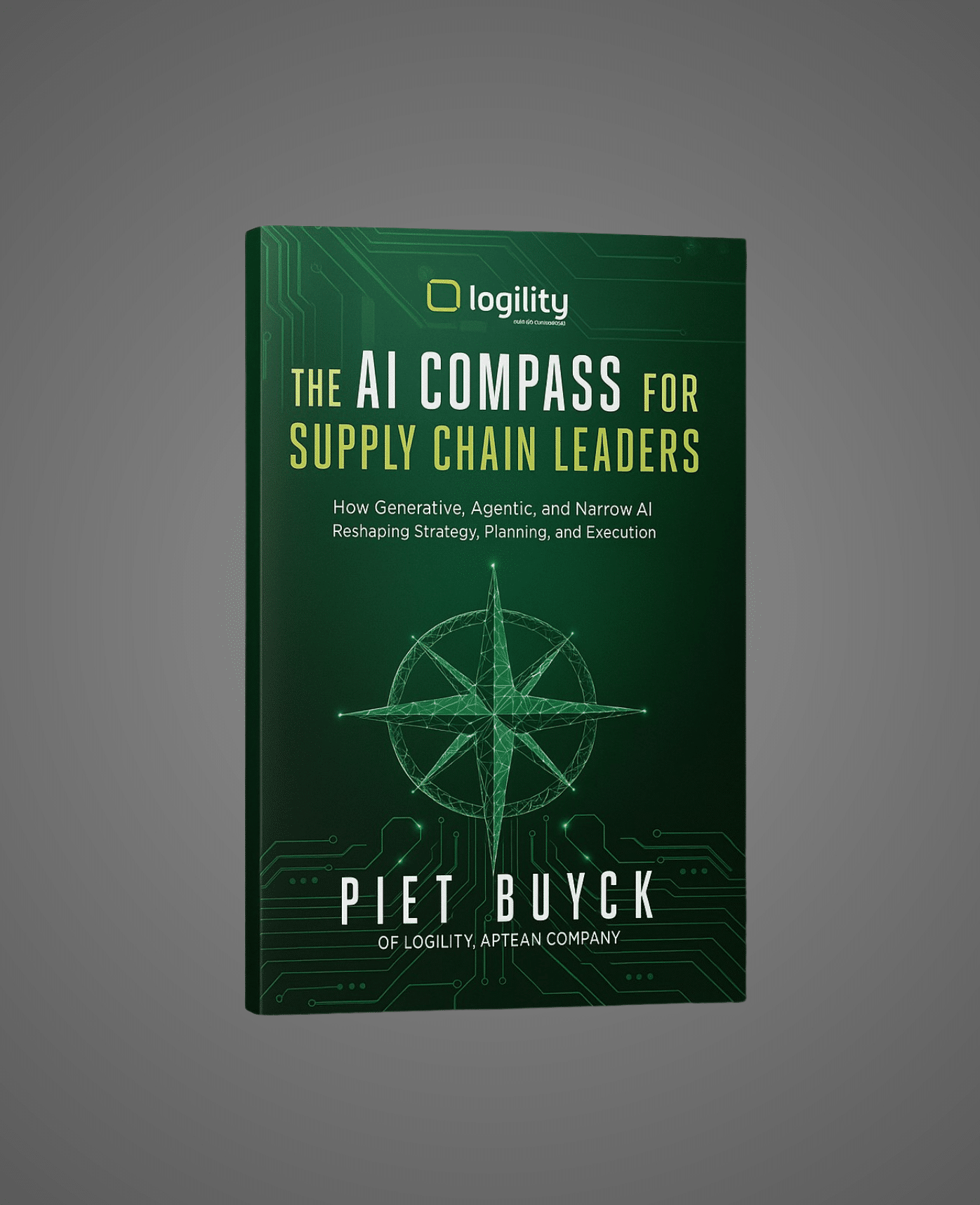
Get my new book, The AI Compass for Supply Chain Leaders
The AI Compass for Supply Chain Leaders introduces a bold new approach where artificial intelligence and human insight work hand-in-hand to drive faster, smarter, and more resilient decisions. Drawing on groundbreaking research and real-world applications, this book reveals how leading organizations are transforming their planning processes to thrive in uncertainty.
Request CopyAgentic AI Adoption and Governance
Supply chain organizations will need to ensure proper governance as they adopt Agentic AI. Oversight is critical, and organizations need collaborative process mapping where decisions are shared by humans and agents for optimal performance. The best applications are those that blend human, digital, and robotic workforces to optimize the strengths across each.
The first step in adopting agentic AI is implementing “human-in-the-loop” guardrails, where agents propose solutions for human approval and refinement. Autonomous agents should also be governed with clear boundaries to ensure compliance and ethical decision-making.Although human touch is critical in the early adoption stage, people can struggle to accept working with AI out of fear that their decades of experience and skills will be made obsolete. One thing that helps is to make it explainable with proposals to show the signals, logic, and expected impact to build trust through transparency. Digital insights may describe the impact on the organization’s plan as a number, but users also receive explanations of how the data was retrieved, which can build faith in the responses. This helps the organization gain the confidence to eventually move to automating low-risk adjustments.
It’s important to also measure not just accuracy but accountability by outcomes and decision time. This is because the real value of an agent is how effectively and quickly it can turn signals into better choices. Performance metrics can include time to assemble information, time to make a decision, data quality, reduced firefighting, and order approval. By involving humans early and taking action, confidence will grow, and organizations can establish a new normal led by control and continuous improvements.
Conclusion
Enhancing generative AI, agentic AI, and autonomous agents enables supply chain organizations to respond to changes in real time. As a digital colleague, the goal isn’t to replace humans but to augment human discernment and judgement. The transparent logic and clear roles keep accountability in the hands of humans while using the AI to boost capacity and the value and accuracy of information.
This will enable traditional processes like S&OP and strategic planning to become more dynamic and better connected to the outside world, with planning levels integrated and enabling real-time information capture and faster alignment. Just as we once moved from standalone tools to enterprise systems and from on-premise software to the cloud, systems will soon become more fluid and take over many manual tasks. This will enable organizations to focus more on what truly matters—delivering better products and experiences to their customers.

Written by
Piet Buyck
SVP, Solution Principle

Short bio
Piet Buyck is a global technology executive with over 30 years of experience in managing and positioning high-value IT applications that disrupt current practices. He is well-known as an influential and strategic business thought leader and entrepreneur with significant achievements and expertise in artificial intelligence, demand sensing, and demand planning.